
Project
TeStaMoni-FLR
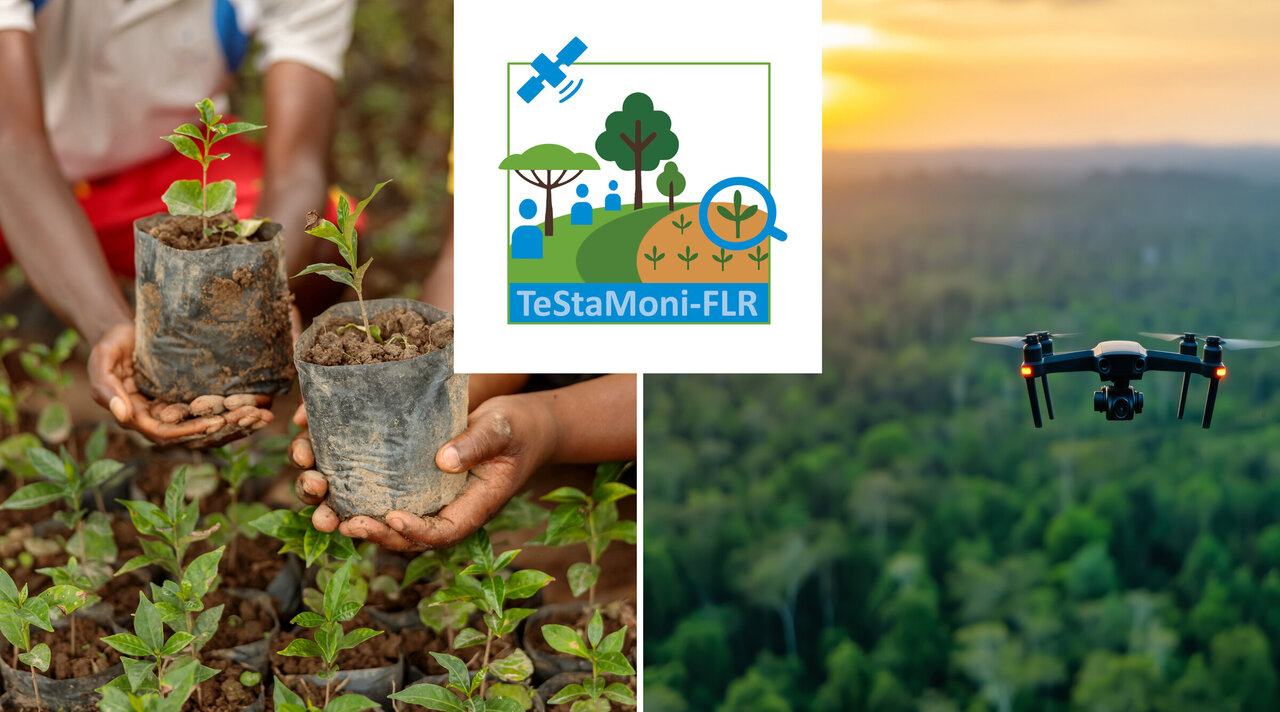
Bridging Technical Feasibility and Stakeholder Perspectives in Large-Scale Monitoring of FLR
This project aims to improve the large-scale monitoring of Forest Landscape Restoration (FLR) by aligning technically feasible methods with the priorities of diverse stakeholders. With a duration of 24 months, the project will develop, refine, and assess monitoring approaches that are not only scientifically robust but also relevant to the needs of donors, governments, and local communities involved in the AFR100 initiative.
Background and Objective
Global initiatives like the Bonn Challenge and AFR100 have mobilized significant commitments to restore vast areas of degraded land. The success of these FLR efforts depends on credible monitoring to guide policy, demonstrate outcomes, and justify investments. However, current large-scale monitoring faces significant challenges, including inconsistencies in data, varying stakeholder needs, and a gap between the potential of advanced technologies and their practical application.
The principal aim of TeStaMoni-FLR is to improve large-scale FLR monitoring by integrating technical feasibility with stakeholder priorities. The project will strengthen existing practices within the AFR100 initiative by developing a roadmap that combines technically feasible monitoring approaches with stakeholder-driven indicators.
Target Group
Donors, National Governments, Sub-national beneficiaries, and Local Communities.
Approach
The project uses a mixed-method approach, drawing insights from case studies in Ethiopia, Madagascar, and Côte d’Ivoire. It combines remote-sensing analysis, statistical modeling, and stakeholder consultations. The work is organized into two integrated work packages (WPs):
- WP1: Technical Perspectives: This package examines the technical feasibility of different large-scale FLR monitoring methods. It involves reviewing current practices, developing and refining area-wide monitoring workflows, and assessing how accurately remote-sensing metrics can reflect on-the-ground FLR outcomes. The project aims to use existing local-scale data from the “Forests4Future” (F4F) project for calibration and validation of these workflows.
- WP2: Stakeholder Perspectives: This package identifies what should be monitored from the viewpoint of key stakeholder groups. Through interviews, workshops, and surveys, it will document stakeholders’ monitoring needs, their perceptions of current systems, and their priorities regarding different indicators and conceptual choices.
The findings from both work packages will be synthesized into an integrated roadmap for large-scale FLR monitoring.
Our Research Questions
We address two linked questions:
- How can large-scale monitoring approaches, such as project-level aggregation or area-wide remote sensing, be made practicable, given emerging datasets and remote-sensing tools?
- Which FLR indicators and conceptual choices are essential for donors, national authorities, and local communities? This includes determining stakeholder priorities on issues such as measuring gross versus net restoration gains and accounting for direct, indirect, and unintentional restoration processes.
Thünen-Contact

Involved Thünen-Partners
Involved external Thünen-Partners
-
Deutsche Gesellschaft für Internationale Zusammenarbeit (GIZ) GmbH
(Bonn, Deutschland)
Funding Body
-
Deutsche Gesellschaft für Internationale Zusammenarbeit (GIZ) GmbH
(national, öffentlich)
Duration
5.2025 - 4.2027
More Information
Project status:
ongoing