

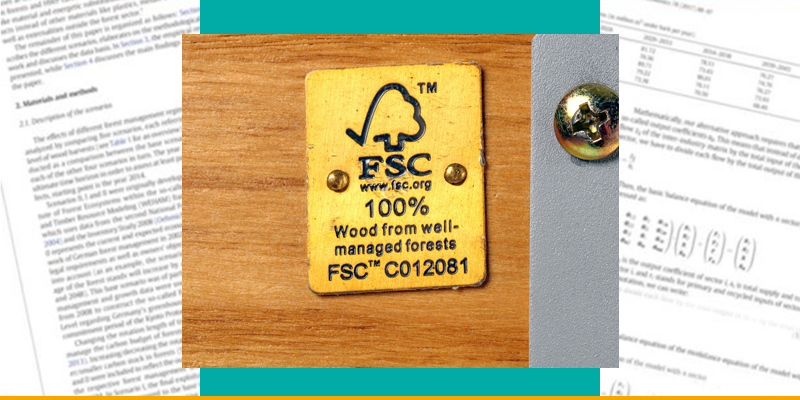
A recently published study tests a number of hypotheses about the relationship between different variables and the uptake of forest certification using econometric estimation techniques with data for 150 countries from 2002 to 2020, focusing on the two most widely used systems worldwide, the Forest Stewardship Council (FSC) and the Programme for the Endorsement of Forest Certification (PEFC).
The study finds that both FSC and PEFC certification density are positively and significantly associated with various dimensions of a country's institutional quality, the level of economic development, the share of forest exports to Europe and the overall export orientation of the forest-based sector.
The study also provides evidence of the important role of environmental NGOs in the uptake of forest certification, with clear differences between FSC and PEFC certification: While there is a positive and significant correlation between the number of environmental NGOs and FSC certification density, the number of environmental NGOs in a country is negatively and significantly associated with PEFC certification density.
- Bösch M (2025) What explains the uneven uptake of forest certification at the global level? New evidence from a panel-data analysis. World Dev 188:106890, DOI:10.1016/j.worlddev.2024.106890
https://literatur.thuenen.de/digbib_extern/dn069265.pdf - Project:
Analysis of forest certification uptake