

Forestry Worldwide
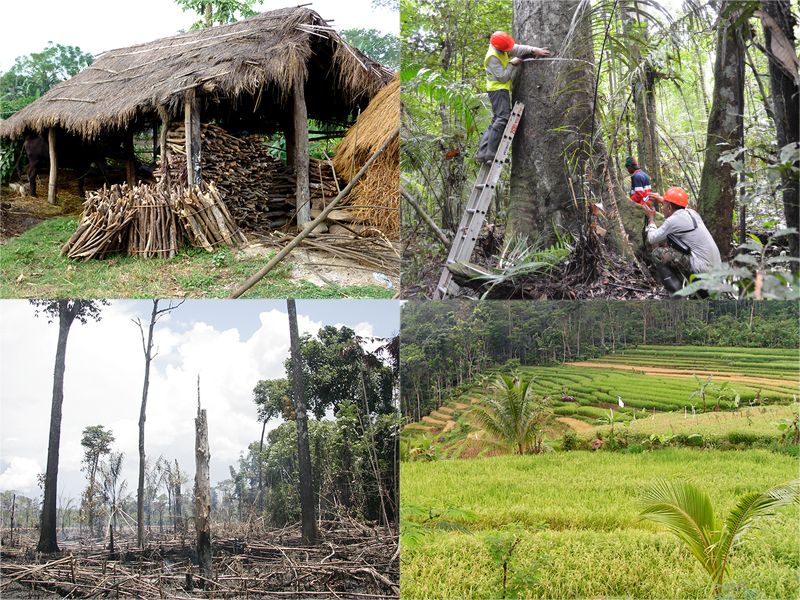
Germany has signed important international framework agreements relevant to forests. We align our scientific agenda with these international commitments and their objectives. In order to promote the contribution of forests and forest management to poverty reduction and climate and biodiversity protection in countries of the Global South, we develop empirical foundations at the local, regional, and national levels/across scales in order to develop evidence-based planning and policy concepts.
The Forest Management Worldwide team at the Thünen Institute of Forestry is dedicated to promoting sustainable forest management and forest landscape restoration, as well as improving forest-dependent livelihoods worldwide, with a particular focus on tropical regions. We combine scientific research with practice-oriented strategy development to counteract deforestation, forest degradation, and climate change. Our multidisciplinary approach integrates social, economic, ecological, and political factors that influence forests in the landscape context.
In our research, we assess ecosystem services and existing governance structures and conduct socio-economic surveys at national and local levels. These are combined with satellite image analysis methods and supplemented by land use models. In addition to analyzing potential conflicts of interest, we also carry out cost-benefit analyses for different restoration options. We also explore integrated landscape approaches as potential instruments for policy implementation at the subnational level.
Our spatial focus is on Africa, Asia, and Latin America. As part of several projects, extensive field studies on these topics have been carried out in collaboration with local partners, e.g., in Ecuador, the Philippines, and Zambia. Supplemented by further studies in the Global South on forest restoration (Madagascar, Ethiopia, Ivory Coast) and on the possibilities for the economically sustainable establishment and use of forests, woodlands, and agroforestry systems, we are attempting to develop transnational, generalizable starting points for a successful and coherent international forest policy, as well as management recommendations and decision-making bases for our partners. In trans-disciplinary cooperation, we analyze the impact of European and German policy measures (e.g., climate policy or EUDR) on countries in the Global South (including Brazil and Indonesia).