[Translate to English:]
[Translate to English:]
Institute of

WO Forest Ecosystems

News

Living organisms leave traces of DNA in the environment in the form of tiny cellular remnants. This makes it possible to detect animals and plants without actually seeing them. In order to pool their expertise in working with eDNA more effectively in future, Thünen staff have now set up a new…

A component of a pipetting robot used for analysis.

The International Co-operative Programme on Assessment and Monitoring of Air Pollution Effects on Forests (ICP Forests) was established over 40 years ago. Since then, measurements have been taken across Europe to assess the impact of air pollution on forests. All the data is compiled at the…

Depositions- und Streufallsammler auf einer Level-II-Fläche unter Kiefer

The WEHAM baseline scenario uses recent data to simulate how Germany's forests could develop over the coming decades. This FAQ explains implications of the results and limitations of the projections.

A close-up of a tree trunk with annual rings, with a pile of wood in the background.

In November 2025, we planted young sessile oaks in the lysimeters in front of the Institute for Forest Ecosystems. In this new experiment, we want to find out how well seedlings from different origins cope with drought.


During the dry years, Germany's forests largely lost their function as carbon sinks. Now it has become apparent that the forest soil compensated for almost all of the negative effects during this period, thus taking over the sink function of the trees. Scientific models must therefore be adapted for…

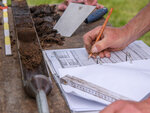
Seitenansicht eines Bodens aus einer Grube im Waldboden mit einem Messstab.

Forest soils store carbon, filter water, and provide habitats for countless organisms. Monitoring them is crucial for detecting changes at an early stage and enabling predictions about the future. Thünen researchers report on the challenges.

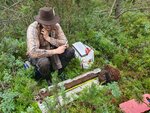
Im Moor kniende Person, die vor sich einen Stechbohrer mit Bodenprofil liegen hat.

eDNA analyses are particularly well suited to recording biodiversity in different habitats more accurately. The Thünen Institute has now launched the "EDNA Lab" for this purpose. It will be based in the EiLT landscape laboratory.

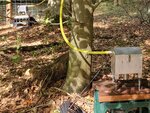
A black collar can be seen on a tree trunk with a yellow hose leading to a metal box.

A functional measurement network for Germany's moorland areas is now in place. A total of 155 measuring points have been set up in open land and forests. Today, Thünen researchers are submitting their report on the development phase to the Federal Ministry of Agriculture, Food and Regional Identity.


The weather in July, which is not particularly suitable for outdoor swimming, is good news for the forest. After the long dry spell in spring, there has now been plenty of rainfall on the Thünen experimental site in Britz. This has compensated for the deficit. The moors are also well filled.

Eine Wasserblase hat sich auf einer Pfütze gebildet.

New Forest Living Labs in the Harz Mountains and in Lower Bavaria: German forest and wood research is reorganising itself for the forests of the future. The SURVEY joint research project, coordinated by the Thünen Institute and the Helmholtz Centre for Environmental Research (UFZ), brings together…

A river in the center of the picture, surrounded by low plants in the background, partly destroyed forest areas, branches of a deciduous tree protrude into the picture in the foreground.

Scroll to top