![[Translate to English:]](/media/_processed_/9/2/csm_Allgemein_Thueringen_Hainich_Mischwald_Bolte_2__19d9dab56a.jpg "[Translate to English:]")
![[Translate to English:]](/media/_processed_/d/2/csm_100_0001_0013_c05c63e7db.jpg "[Translate to English:]")
Soil water
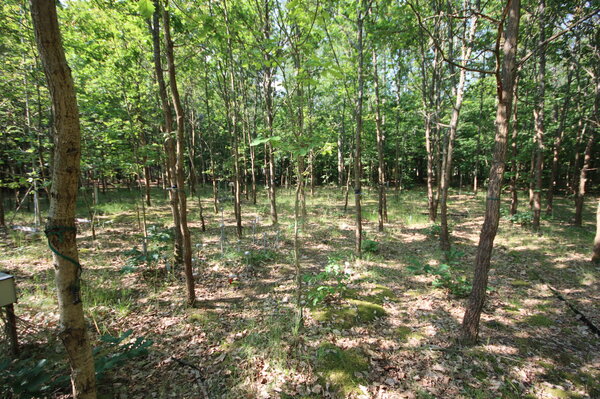
The soil has an important function as a water reservoir. It supplies plants with water and balances out the phases between surplus and deficiency when evaporation exceeds precipitation.
The soil water content is used as a measurement to describe the soil water in percent by volume. The water is distributed differently in the soil. For this reason, we measure the water content in the soil at three points in the lysimeters in Britz using rod-shaped sensors at 10 different depths. In winter, when evaporation is low, the water reservoir fills up, whereas in summer the water reservoir is reduced by the high evaporation of soil and vegetation.
How much water can be retained in the soil depends on the size of the interstitial spaces (pores) in the soil. Water can be retained more in small pores than in large ones. The large pores between the sand, for example, cannot hold much water. However, sandy soils are often very deep. This means that plants that can root deeply can use a larger area of the soil.
Why are soil water content measurements important? They tell us something about water availability and deficiency. They are important when considering the water balance and for balancing. Ultimately, the soil water content is also an important input variable for water balance modeling.