[Translate to English:]
[Translate to English:]
Institute of

FI Fisheries Ecology

News

Living organisms leave traces of DNA in the environment in the form of tiny cellular remnants. This makes it possible to detect animals and plants without actually seeing them. In order to pool their expertise in working with eDNA more effectively in future, Thünen staff have now set up a new…

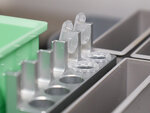
A component of a pipetting robot used for analysis.

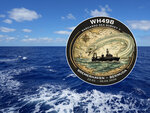
Six researchers from the Thünen Institute are on a research expedition in the Sargasso Sea to study European eel larvae. They are joined by 30 other people on board the Walter Herwig III. You can follow the month-long voyage in the see blog.

A circular logo depicting the eel expedition with the Walther Herwig II set against a nautical chart and encircled by an eel. The inscription reads: WH 498, Saragasso Sea Survey V Bremerhaven – Bermuda 23 February – 30 April 2026.

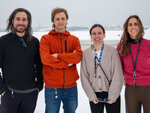
With the scientific team now complete, the Thünen Institute of Fisheries Ecology is launching an ambitious project to restore the European flat oyster in the North Sea.

Foto von vier Wissenschaftler/innen

During the 18th Global Food Forum Agriculture (GFFA) from 14 to 17 January in Berlin, participants will discuss the increasing water scarcity in food systems and potential solutions. The Thünen Institute is organising two expert panels on this topic.

In the foreground, two blurred figures stand in the shadows, behind them is a logo with a sphere surrounded by lines depicting various animals.

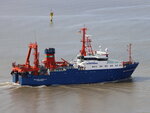
The fisheries research vessel Walther Herwig III is currently sailing the North Sea and Baltic Sea to investigate radioactive substances, heavy metals, and organic pollutants, as well as their effects on biological systems. Find more in our sea blog.

The ship photographed from the side. It is painted blue (hull), orange (superstructure), and white (bridge).

New study sheds light on metal and temperature effects on oyster larvae.

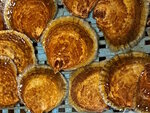
Mehrere Austern in Kiste

How does the regionalization of marine aquaculture influences sustainability?

Netzkäfige für die Lachszucht schwimmen im Wasser

3,355 - that is the number of barrels of nuclear waste found and mapped by an international research team during a four-week expedition to the Iberian deep sea. Today, Friday morning, July 11, the research vessel L'Atalante arrived back in Brest, France.

 A barrel lies on a sandy seabed and is overgrown with marine life.

Elin Wefer at the 5th Seminar Days of the Thünen Institute of Fisheries Ecology

[Translate to English:]

Students from the WASCAL program gathered in Bremerhaven to discuss the sustainable use of aquatic resources – building a bridge between West Africa and Northern Germany.

Gruppenfoto in der Aquakulturanlage

Scroll to top