
![[Translate to English:]](/media/_processed_/c/9/csm_IMG_9714_54f92c380d.png "[Translate to English:]")
The European Association of Agricultural Economists (EAAE) is considered one of the most important platforms for agricultural economic research. This year, the federal city of Bonn is hosting the 18th EAAE Congress under the motto “Food System Transformation in Challenging Times.” The Thünen Institute will be present with numerous lectures and posters as well as topic-specific working groups (organized sessions). In the working groups, participants will not only be able to network across disciplines, but above all discuss current research topics in depth. The 45 contributions in which scientists from the Thünen Institute are involved cover a wide range of topics that are important for the sustainable development of the agricultural and food industry and demonstrate the diverse internal and external collaborations of the Thünen Institute. “Our research is internationally recognized and respected,” says Dr. Hiltrud Nieberg, head of the Thünen Institute of Farm Economics. “We consider it an honor that so many contributions have been invited,” says the scientist.
The research presented by the Institute of Farm Economics focuses on topics such as adaptation options and hedging instruments for agricultural businesses in the context of climate change, options and policy instruments for reducing greenhouse gases and nutrient surpluses, the role of women as farm managers in agriculture, citizens' perceptions of “living lab approaches,” and the impact of support programs to improve animal welfare.
The contributions of the Institute of Rural Studies focus on the effects of farmers' protests, the implementation and evaluation of the policy instrument of eco-regulations, analyses on the implementation of the Nitrates Directive and challenges in rural areas.
The Institute of Market Analysis examines the effects of trade policies such as tariffs, the role of agricultural and forestry policy, and the market effects of global crises such as the coronavirus pandemic or policy options for preventing deforestation.
The Institute of Rural Economics presents the effects of drought on internal migration in Ethiopia.
Scientists from the Coordination Unit Climate, Soil, Biodiversity present tools for emissions accounting at the farm level and analyze policy measures to reduce greenhouse gas emissions in agriculture.
The annual conference of Gewisola (Society for Agricultural Economics and Social Sciences) is also taking place in Bonn at the same time as the Agricultural Research Congress.
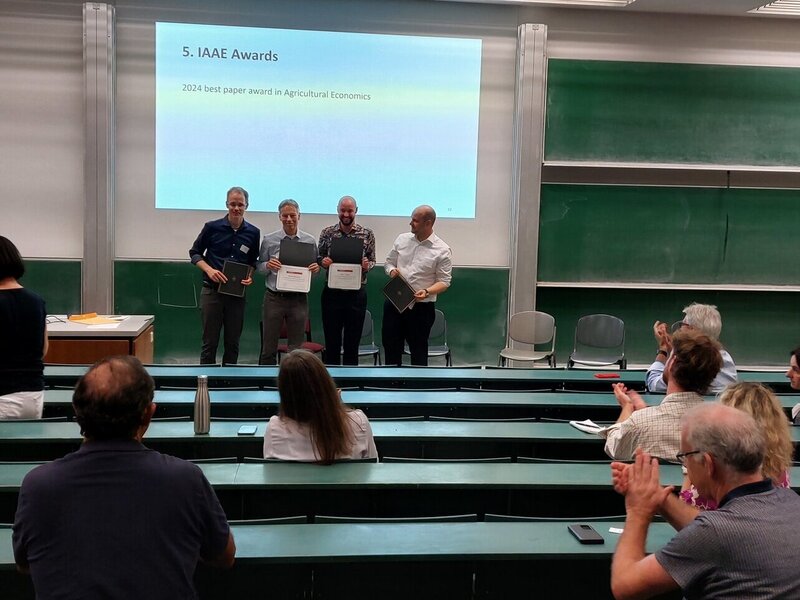
The society also awarded its prize for the best dissertation. It went to Jonas Schmitt, who wrote his doctoral thesis on reducing weather-related crop losses by growing a wider range of crops – and the role that insurance plays in this. For the resulting paper, published in Agricultural Economics in 2024, he and his co-authors Frank Offermann, Andreia Ribeiro and Robert Finger also received the EAAE award for the best paper.
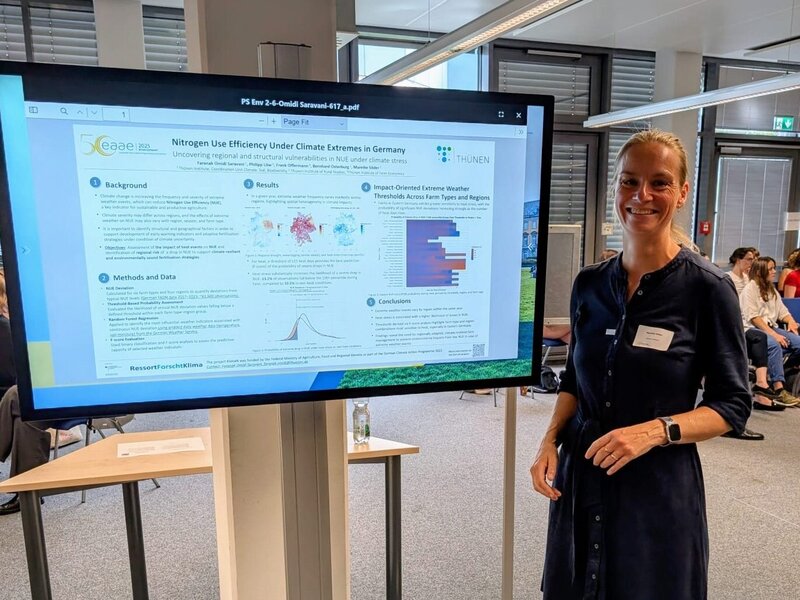
The prize for the best scientific poster at the congress also went to Thünen researchers: for the presentation of the KlimaN project, which investigates the effects of extreme weather on nitrogen use efficiency and possible adaptations of fertilisation to climate change. The authors of the poster are Faranak Omidi Saravani, Philipp Löw, Frank Offermann, Bernhard Osterburg and Mareike Söder.