![[Translate to English:]](/media/_processed_/6/4/csm_titel_CO2Kampagne8_afeea2273e.png "[Translate to English:]")
![[Translate to English:]](/media/_processed_/4/1/csm_titel_93px_CO2Kampagne8_9b0f3354d4.png "[Translate to English:]")
Ammonia (NH3) emissions affect the environment, climate and human health and originate mainly from agricultural sources like synthetic nitrogen fertilizers. Accurate and replicable measurements of NH3 emissions are crucial for research, inventories and evaluation of mitigation measures. There exist specific application limitations of NH3 emission measurement techniques and a high variability in method performance between studies, in particular from small plots. Therefore, the aim of this study was the assessment of measurement methods for ammonia emissions from replicated small plots. Methods were evaluated in 18 trials on six sites in Germany (2021–2022). Urea was applied to winter wheat as an emission source. Two small-plot methods were employed: inverse dispersion modelling (IDM) with atmospheric concentrations obtained from Alpha samplers and the dynamic chamber Dräger tube method (DTM). Cumulative NH3 losses assessed by each method were compared to the results of the integrated horizontal flux (IHF) method using Alpha samplers (Alpha IHF) as a micrometeorological reference method applied in parallel large-plot trials. For validation, Alpha IHF was also compared to IHF/ZINST with Leuning passive samplers. Cumulative NH3 emissions assessed using Alpha IHF and DTM showed good agreement, with a relative root mean square error (rRMSE) of 11%. Cumulative emissions assessed by Leuning IHF/ZINST deviated from Alpha IHF, with an rRMSE of 21%. For low-wind-speed and high-temperature conditions, NH3 losses detected with Alpha IDM had to be corrected to give acceptable agreement (rRMSE 20%, MBE +2 kg N ha−1). The study shows that quantification of NH3 emissions from small plots is feasible. Since DTM is constrained to specific conditions, we recommend Alpha IDM, but the approach needs further development
News
Paper from the project NH₃-Min
© Thünen-Institut/Andreas Pacholski
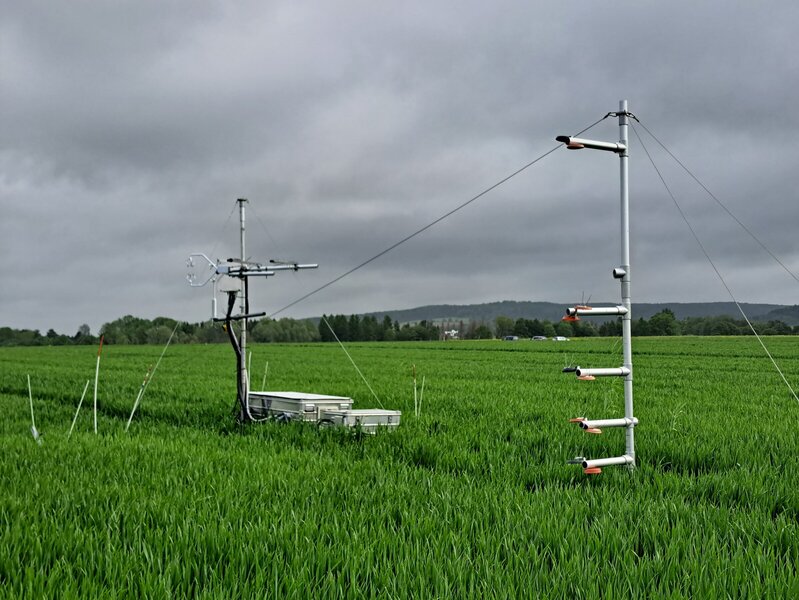
Measurement of NH₃ emissions using standard methods on a reference plot at the Sickte site near Braunschweig
Scroll to top