![[Translate to English:]](/media/_processed_/6/4/csm_titel_CO2Kampagne8_afeea2273e.png "[Translate to English:]")
![[Translate to English:]](/media/_processed_/4/1/csm_titel_93px_CO2Kampagne8_9b0f3354d4.png "[Translate to English:]")
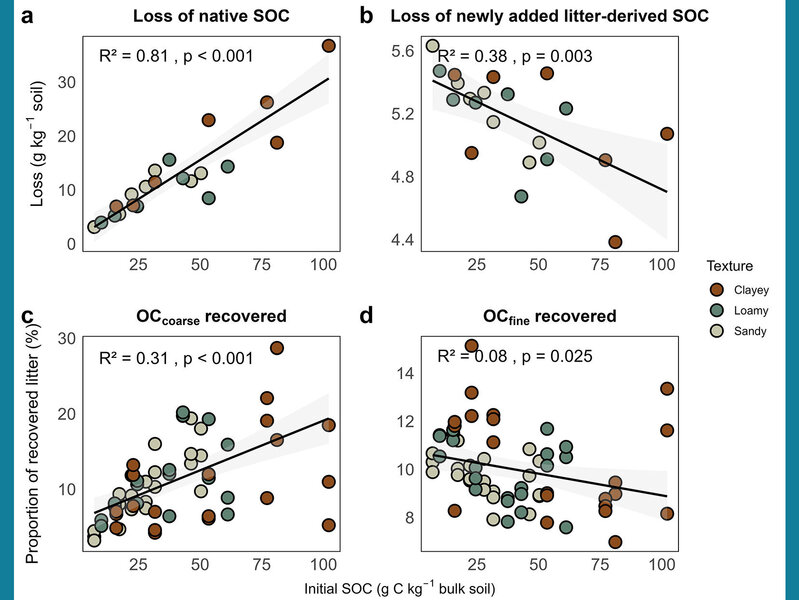
In this study, we carried out a two-year incubation experiment using 21 temperate agricultural soils that differed in their initial soil organic carbon (SOC) contents. We added 13C-labeled plant litter to trace how new carbon is decomposed and stabilized. Throughout the experiment, we measured carbon retention in bulk soil and fine/coarse fractions, as well as carbon losses as CO2. Selected samples were further analyzed using NanoSIMS imaging to visualize microscale carbon accumulation.
We found that soils with higher existing SOC retained a slightly larger share of newly added carbon, and that new mineral-associated carbon continued to form even in soils with high fine-fraction carbon loadings. This suggests that, within the range we studied, initial SOC levels did not strongly limit mineral-associated carbon formation, and that microbial processing and microscale organic matter patterns are important for stabilization.