![[Translate to English:]](/media/_processed_/6/4/csm_titel_CO2Kampagne8_afeea2273e.png "[Translate to English:]")
![[Translate to English:]](/media/_processed_/4/1/csm_titel_93px_CO2Kampagne8_9b0f3354d4.png "[Translate to English:]")
Land-use change (LUC) — for example, converting cropland into forest or grasslands into croplands — alters soil organic carbon (SOC) storage. How much SOC changes following LUC varies by soil depth and LUC type. Here, we combined data from the German Agricultural Soil Inventory with data from the National Forest Soil Inventory and applied new data-driven space-for-time approaches to model site-specific effects of LUCs on SOC stocks across Germany. We found that about 30% of the SOC change occurs below 30 cm depth. Furthermore, that LUC-induced SOC change is driven by soil type and precipitation. LUC effects on SOC stocks tended to be greatest at sites with shallow groundwater, few rock fragments and/or relatively low precipitation. This research draws focus to the importance of deeper soil sampling for accurate carbon accounting and climate change mitigation strategies.
News
New publication: Drivers of soil organic carbon change following land use change
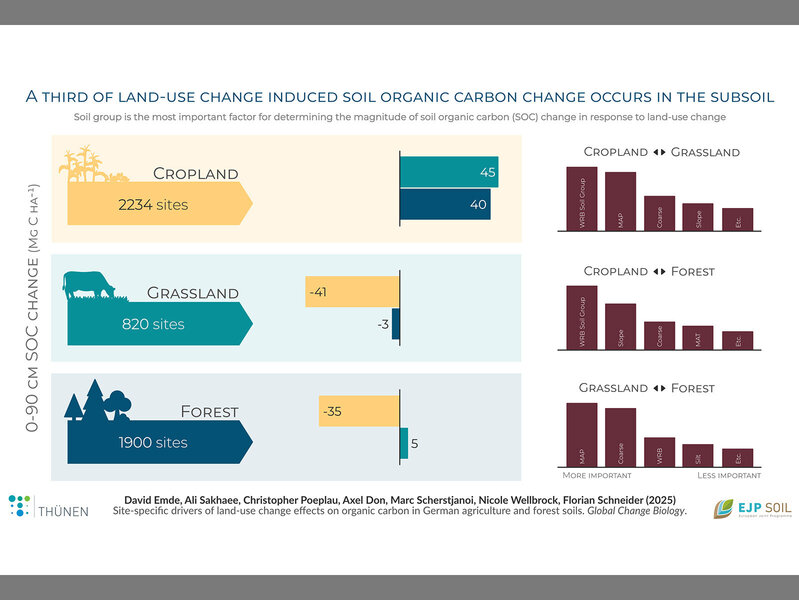
© Thünen-Institut/David Emde
Scroll to top