![[Translate to English:]](/media/_processed_/6/4/csm_titel_CO2Kampagne8_afeea2273e.png "[Translate to English:]")
![[Translate to English:]](/media/_processed_/4/1/csm_titel_93px_CO2Kampagne8_9b0f3354d4.png "[Translate to English:]")
Included are contributions from the project as well as other contributions on the topic, see:
https://link.springer.com/journal/374/volumes-and-issues/61-3
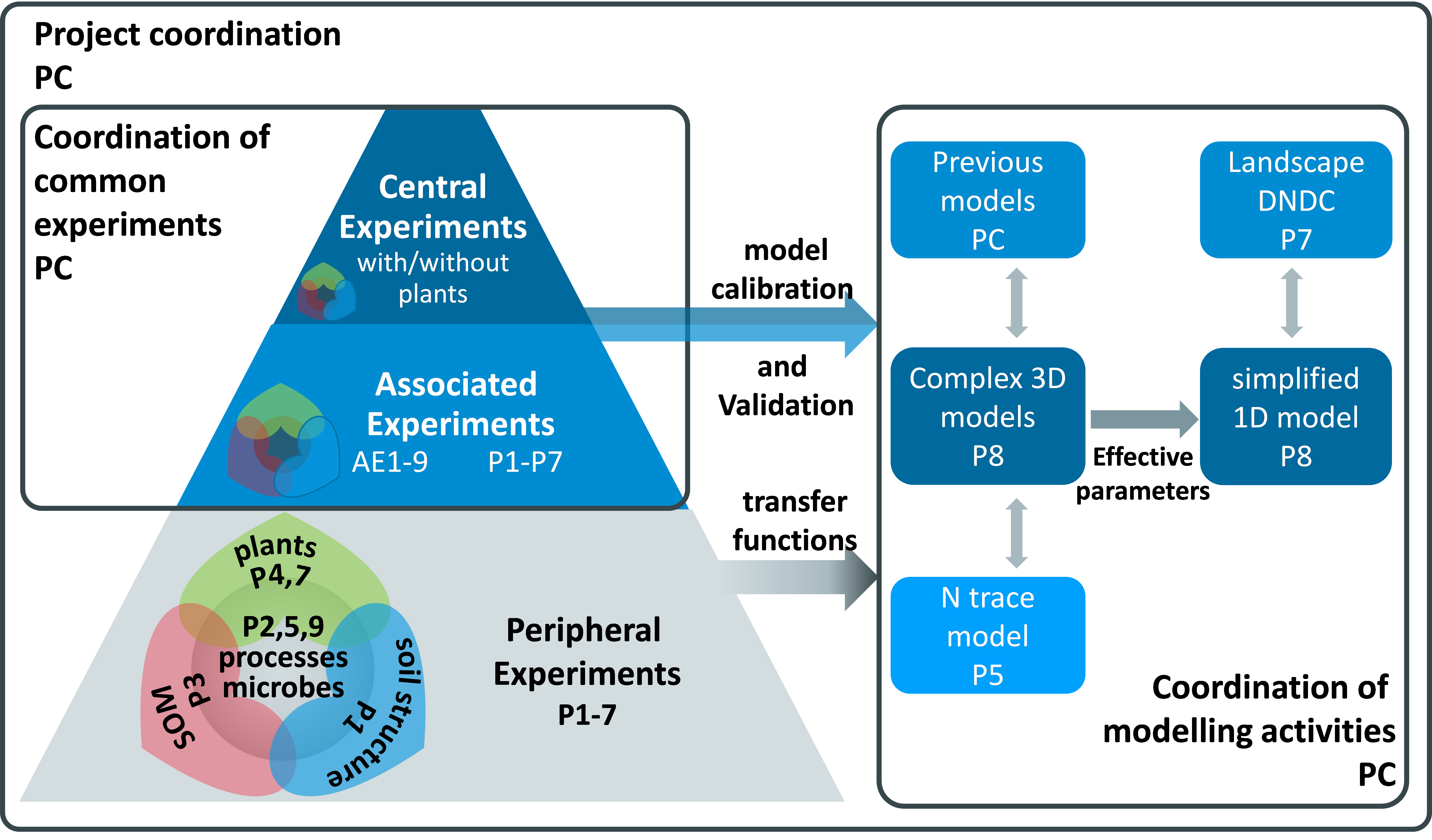
The motivation for the project was the lack of robust measurement data on N2 emissions and oxygen depletion in the soil in order to reliably predict gaseous nitrogen losses from agricultural soils through microbial processes. The main aim of the research group was therefore to close this gap by means of field and laboratory studies and by further developing models.
The quantification of denitrification in soil is a crucial prerequisite for reducing N2O emissions and the loss of fertilizer nitrogen. Robust data sets for the validation of N2 fluxes from denitrification models are scarce, mainly because suitable methods are only available to a limited extent, but also because denitrification processes are extremely heterogeneous in space and time. Using analytical and molecular biological methods as well as field experiments and various modeling approaches, we investigated the process chain of denitrification in agricultural soils from the microscale to the field scale. The aim was to analyze denitrification processes with an unprecedented spatial and temporal resolution. Based on the results, we wanted to develop mathematical models from the microscale to the field scale and improve existing simulation models.
The editorial of the special volume provides an overview of the results achieved and the questions that remain unanswered. The prerequisite for progress was the combination of innovative methods including the development of new approaches. From our experimental work on the influence of soil structure, the spatial distribution and reactivity of substrates, microbial ecology and plant effects, in-depth and in some cases new insights into the regulation of denitrification were obtained and associated data were used for the development and testing of new models. Thünen played a diverse role in the project network, starting with initiating the project and participating in the planning and coordination. Our other focal points included isotope analysis, the further development of methods for recording denitrification, their application in laboratory and field experiments and participation in modeling tasks. Important results were as follows.
To realize data sets on N2 and N2O emissions from denitrification in field experiments or under defined conditions in the laboratory, classical stable isotope methods were combined with innovative gas exchange measurement systems under artificial atmosphere. Isotope tracer methods were compared with the natural abundance of isotopic signatures of N2O emissions to validate and improve the results of both approaches.
New insights into the regulation of denitrification were gained through emission measurements in combination with new approaches in computer tomography, with the help of which the distribution of water and organic residues in the pore space structure could be determined. This showed that the intensity of denitrification depended primarily on those organic residues that were isolated from oxygen exchange with the atmosphere. These measurements, among others, led to new concepts for determining and interpreting the anaerobic soil volume as a control variable for denitrification. The direct promotion of the emission of N2 and N2O through the activity of roots has been demonstrated several times, although the contribution of root excretions and root respiration to this effect must be investigated further in the future. New research questions have arisen with regard to the significance of the origin and the state of decomposition for the long-known promotion of denitrification by plant residues in the soil. We expect these results and the further processing of the factors mentioned to provide important starting points for the improvement of models. In order to pursue this further, the follow-up projects MinDen and Mofane2 are already underway at our institute.
The modeling tasks included the testing of existing models, their further development and the development of completely new approaches based on the pore scale. Thünen initially initiated and supported the exchange with the international modeling community in the form of workshops. Furthermore, we used data sets on N2 emissions for the first time under defined laboratory conditions to test three existing models. As a result, the calculated N2 emissions differed by up to 4 orders of magnitude, which drastically confirmed the urgency of improving N2 modeling.
Overall, the experiences and results from DASIM have ultimately shown that even after more than 200 years of research into denitrification, progress can still be made to better understand this process in the context of the nitrogen cycle in terrestrial ecosystems. The interdisciplinary nature of DASIM has been absolutely essential for the development and combination of methods that have not yet been used on this scale. It is this synergistic effect of interdisciplinary research that has been crucial to the progress of DASIM. Although we have addressed a number of key aspects to take our understanding of denitrification to a higher level, a number of issues have not yet been resolved or addressed, such as the role of subsoils, interactions with higher animals, but also chemical transformations and soils not previously considered in DASIM, such as the organic soils.