![[Translate to English:]](/media/_processed_/d/7/csm_Startseite-OF_03_c0dfd6e750.png "[Translate to English:]")
![[Translate to English:]](/media/_processed_/a/3/csm_20181116-151457-Stella-Jerome-Fischfalle-Warnem%C3%BCnde-Dorsche-im-Netzk%C3%A4fig-5691_heller_3050c72fa2.png "[Translate to English:]")
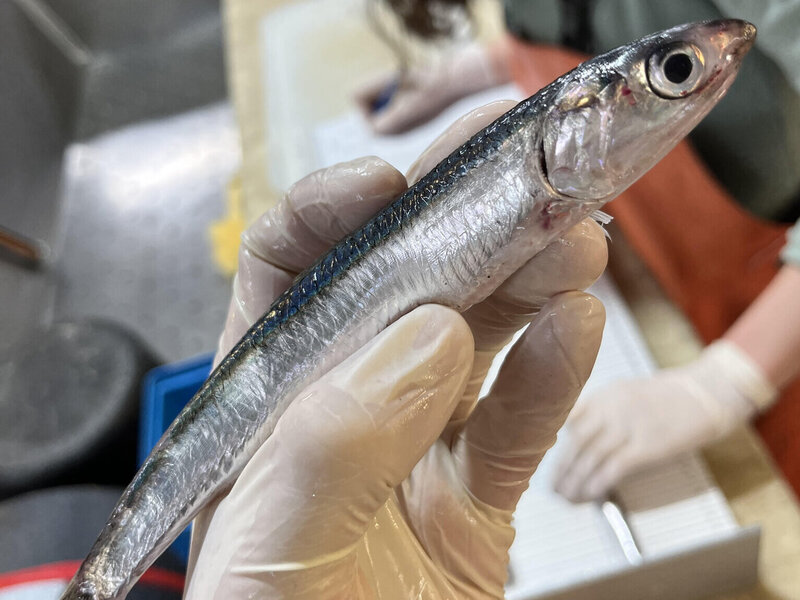
Anchovies have so far played hardly any role in the culinary consciousness in these latitudes. Most people in Germany are familiar with them at best as a pizza topping (‘anchovies’) or as an ingredient in spicy pastes. Less well known, however, is the immense, albeit indirect, importance of anchovies for our fish consumption: A large part of the feed for aquaculture salmon and other fish consists of fishmeal, which comes from large industrial fisheries targeting small schooling fish such as the Peruvian anchovy. Could the European anchovy also become a lucrative target for fishing in the North Sea and Baltic Sea in the future if stocks continue to grow and expand?
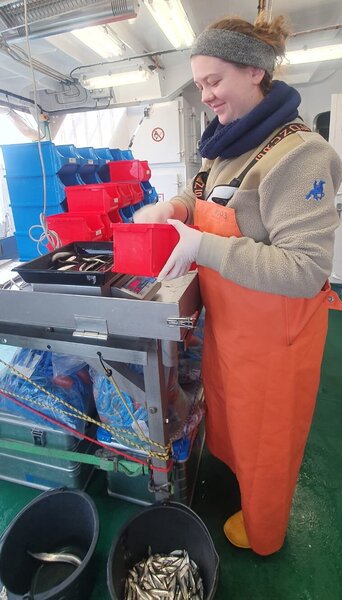
As part of her thesis at the University of Rostock, supervised by Dr Paul Kotterba and Dr Stefanie Haase, Jule Berrit Baum investigated whether there is evidence of an increase in anchovies in the western Baltic Sea. She analysed the data series from an important hydroacoustic survey conducted annually in cooperation between the Thünen Institutes of Baltic Sea Fisheries and Sea Fisheries. Although anchovies have not yet attracted the interest of the fishing industry due to their low numbers, the results of the study suggest that the species could become more important in the future. The data show that anchovies have long been an established part of the fish community in the western Baltic Sea and have become more common in the last two decades. In addition, they have significantly expanded their range. The environmental data consulted show that a key factor in this development was an increase in water temperature during this period. It therefore seems possible that a further rise in temperatures due to climate change could lead to an increased occurrence of anchovies in the Baltic Sea, even though many other influencing factors (competition with other species, predators, etc.) could not be considered in the current study.
Another particularly valuable aspect of Ms Baum's master's thesis was the development of the first abundance index for anchovies in the Baltic Sea, which was based on and adapted from existing indices for commercial species (herring and sprat). This new tool will now make it possible to continue monitoring the development of anchovies in the Baltic Sea and to take timely management measures if the species becomes of interest to fisheries. With the successful defense of her master's thesis, Ms Baum completed her studies in Rostock as the best in her class (Integrative zoology).