![[Translate to English:]](/media/_processed_/3/6/csm_Hintergrund-Ausschnitt1_9daaef6b89.jpeg "[Translate to English:]")
![[Translate to English:]](/media/_processed_/3/6/csm_Hintergrund-Ausschnitt1_0bd7111163.jpeg "[Translate to English:]")
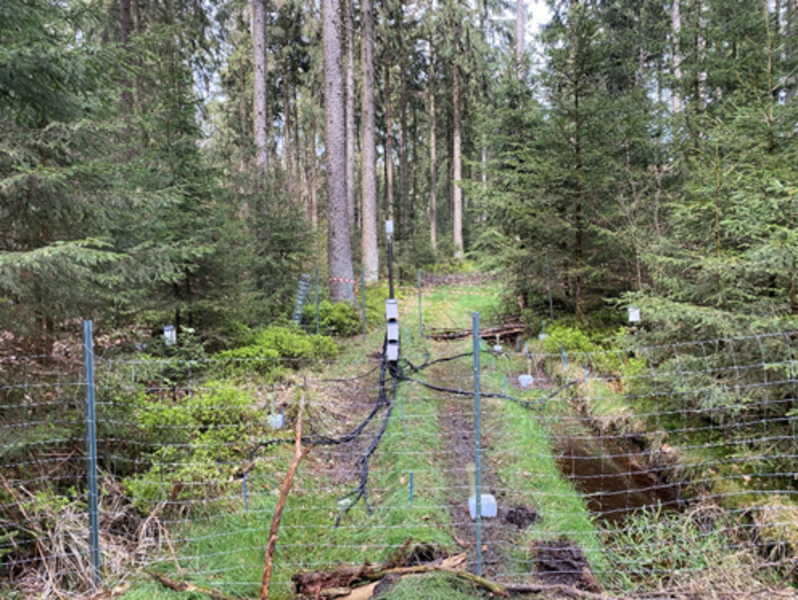
Heavy harvesting machines in forestry put strain on the soil. The project “Soil water dynamics in forest skid trails – identification and prediction of critical conditions (CritTrails)” involves a multi-year study of soils in skid trails. The aim of the studies is to identify critical conditions affecting trafficability and to issue recommendations for action in practice.
In spring 2024, monitoring began at two locations in Solling and on the grounds of the Thünen-BVL campus. While the soil under spruce and beech trees is being studied in the Solling low mountain range, the site in Braunschweig is covered with oak trees. The project has now been extended until May 2026. This will enable us to carry out soil hydrological monitoring for another winter and thus record an additional period of potentially critical conditions.
Significantly wetter soils in winter
The majority of annual timber harvesting in forestry takes place during the winter months. This period also poses a particular challenge for soil protection, as heavy vehicles often drive on soil that is wetter and more susceptible to compaction.
Initial results from the project confirm this: during the winter months, the soil in the tracks is significantly wetter. In some places, water accumulates on the soil surface in the tracks for several months. In the untracked areas of the forest soil, the water seeps away much more quickly, so that these soils are less moist and dry out faster. In the past two summers, however, the tracks dried out significantly less than the uncompacted reference soils.
Uncertainties and surprises
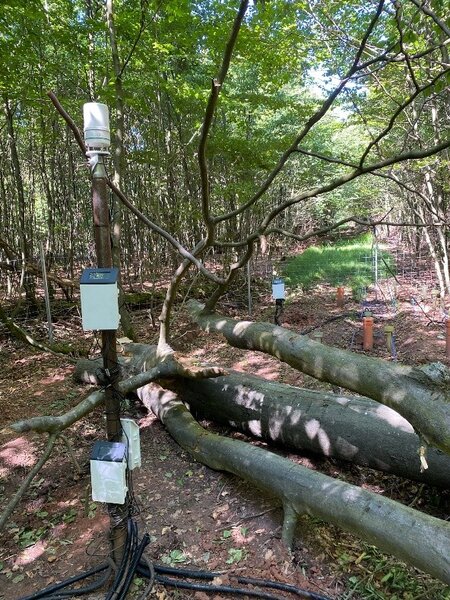
However, our investigations have also shown that not everything can be planned and that sometimes small or big surprises await us when we visit the test areas. For example, a large beech tree fell into this area during a storm. Fortunately, the tree fell into the only open area where no sensors were installed, so no significant damage was caused. Only the fence had to be rebuilt.
Outlook
As the project progresses, the measurement data collected from the monitoring will now be linked to the results of the laboratory tests so that the model forecast of the water content can be carried out and validated for the three locations. Next winter, felling measures will be monitored on site and our recommendations for action regarding the passability of the soil will be reviewed with stakeholders from the field.
Funding
The project was funded by the Federal Ministry of Food, Agriculture, and Rural Affairs (BMLEH) on the basis of a resolution of the German Bundestag via the Federal Office for Agriculture and Food (BLE). Funding code: 2220NR039X, funding program: Fachagentur Nachwachsende Rohstoffe e.V. (FNR)