![[Translate to English:]](/media/_processed_/3/6/csm_Hintergrund-Ausschnitt1_9daaef6b89.jpeg "[Translate to English:]")
![[Translate to English:]](/media/_processed_/3/6/csm_Hintergrund-Ausschnitt1_0bd7111163.jpeg "[Translate to English:]")
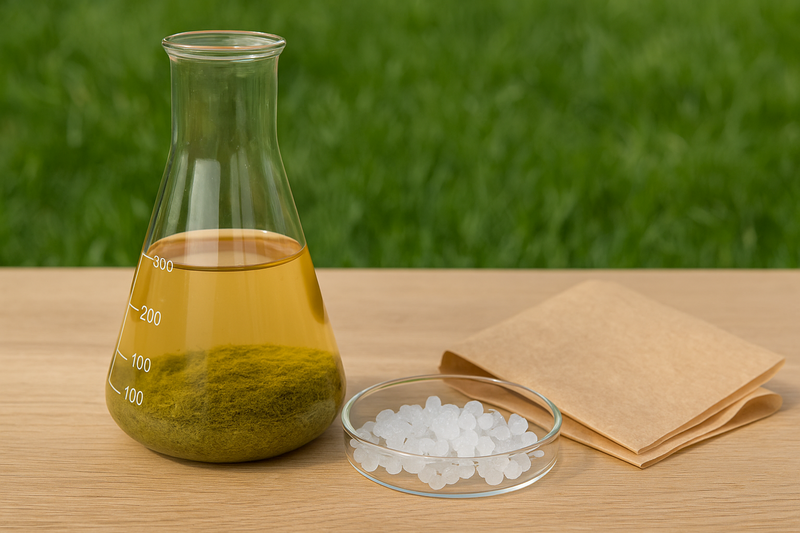
Launched on October 1 and running for three years, the Presswert project brings together the expertise of the Thünen Institute of Agricultural Technology and the Thünen Institute of Wood Research. Together, the researchers are developing processes to transform press residues from the extraction of proteins from green biomass into valuable products – hydrogels for agriculture and paper fibers for industry.
Grass as a Resource with Potential
Permanent grassland is important not only for feed supply but also for soil and water protection and as a carbon sink. At the German Institute of Food Technologies (DIL), researchers are investigating how proteins can be extracted from grassland plants for use in food and feed. The process produces a solid press residue – a largely unused by-product with significant potential.
From Press Residue to Functional Material
This is where the Presswert project comes in: the Thünen Institutes use the press residues to create valuable materials. The Institute of Agricultural Technology focuses on the hemicellulose fraction, which is chemically modified and transformed into hydrogels. These gels can store large amounts of water and slowly release it to plants – an advantage in increasingly dry periods. Unlike many synthetic hydrogels, hemicellulose-based materials are biodegradable and environmentally friendly.
Fibers for Sustainable Paper Production
The Thünen Institute of Wood Research investigates the cellulose-rich fiber fraction of the residues. The goal is to develop simple yet efficient methods that allow paper mills to produce high-quality fresh fibers directly from grass. This approach can reduce dependence on recycled paper, whose quality has declined due to rising recycling rates. Using annual plants such as grass expands the raw material base for paper production and promotes new, sustainable value chains.
Collaborating for Maximum Value
Both institutes work closely to coordinate the extraction processes for hemicellulose and cellulose. The aim is to ensure that all biomass fractions are utilized to achieve maximum material value. In doing so, the Presswert project contributes to the sustainable use of biomass while enhancing the economic viability of protein extraction from grassland.