Interview
‘Organic in a dilemma’
Kathrin Rieck with Heike Kuhnert, Marie von Meyer-Höfer und Georg Rieck | 29.09.2023
The organic food retail sector experienced a peak in sales during the coronavirus pandemic, which have since dropped back to below the 2019 levels. At the same time, sales of organic products in retail (LEH) are rising. This leads to a dilemma for organic trade: the organic principles that organic food retailers stand for are in contrast to the prevailing market system which is driven by low prices and convenience. Given this context, can organic food survive – or even grow – without compromising on quality? We discussed this with organic farming expert Heike Kuhnert (HK), organic shop owner Georg Rieck (GR) and market researcher Marie von Meyer-Höfer (MvH).
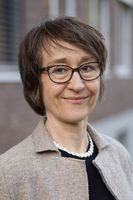
Dr. Heike Kuhnert: Researches and answers questions about the future and development of organic farming in Germany at the Thünen Institute of Farm Economics. She studied Agricultural Economics and Ecological Environmental Protection.
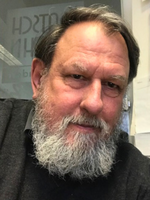
Georg Rieck: Co-founder, managing director and owner of Klatschmohn Naturkost GmbH in Giessen for 40 years. The agricultural scientist is a member of the Food Council Giessen.

Dr. Marie von Meyer-Höfer: Researches at the Thünen Institute of Market Analysis in the field of consumer research and is involved in ongoing projects such as ‘On the way to 30 percent organic farming’.
Mr Rieck, as an organic food shop owner, you were among the winners of the coronavirus pandemic and you now see yourself on the losing side. How are you experiencing the current events?
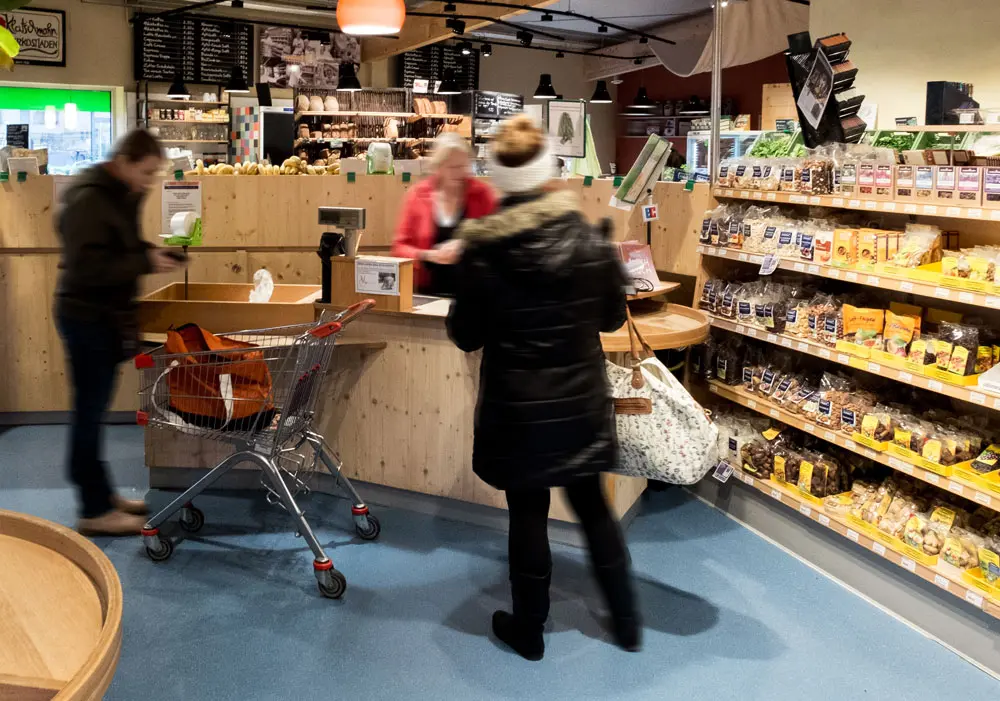
GR: We have been an owner-managed organic shop in Giessen, Hesse, from the very beginning, since 1978. Over the years, we have been able to grow from 18 to 400 square metres of retail space. After the sales peak in the pandemic, sales dropped back to the 2019 level. We can compensate for this with simple commercial tools such as cutting costs, reducing the workforce and adjusting prices, partly because we no longer have any burdens from loans. Some of our producers and suppliers are being hit much harder, as the low product turnover is a problem for them. In addition, many have built on growth and now have to finance production capacities that cannot be utilised.
MvMH: From an economic point of view, if you ignore individual fates, the drop in sales in the organic sector is not actually dramatic. But because it is the organic market, which has otherwise been rather spoilt in this respect, the decline in sales is being sold as dramtic in the media and in the public debate around the promotion of the organic sector.
HK: Yes, and according to the latest figures, sales are rising again. It will be exciting to see what the actual figures for the various sales channels such as organic food shops, farm shops and food retailers will be at the end of 2023.
In your view, what is the ‘organic dilemma’?
GR: I think that the focus on CO2 obscures the view of very important ecological problems for the agricultural sector: above all the decline in biodiversity, fertilizer surplus, soil degradation and animal welfare. The fact that not a single flower can be found in the cadastral district in May or June is the result of modern farming methods and a visible sign of disaster. The market is forcing farms into sizes and methods in which the organic system no longer works, because agro-ecosystems urgently need small-scale systems and diversity. We old-school organic shops have made it our mission to market the products of organic farming, which require a great deal of explanation, and the creation of a protected space for them in which they are less exposed to the harsh laws of the market. To this end, we had developed an alternative world view for the entire supply chain that was very much at odds with the prevailing perceptions. In this way, we conveyed an alternative attitude to life to our customers and created an alternative lifestyle with our products. Today, this attitude is in danger of being lost because it can no more survive in the anonymous mass market than the diversity of insects in the flowerless field. It is not compatible with organic methods if the mass of consumers wants a lot, cheap and convenient!
MvMH: Organic goods are trust goods in terms of information economics - without help, the consumer has no information about the apple's production process. The consumer therefore needs credible labelling certifying organic quality, for example in the form of an organic label. However, organic labels are often also at risk of triggering a ‘halo’ effect, which leads to consumers interpreting all kinds of positive, desirable characteristics into products with an organic label that do not necessarily cover the standards behind them. Organic is about holistic sustainability in the system, not about individual aspects such as ‘healthier’ or something like that. And a personal dilemma for me as a market researcher is knowing that there is a huge difference between consumers' knowledge and their purchasing behaviour.
HK: Which is a core problem: since the Second World War, we have been living in a marketing-orientated advertising and consumer society - following the example of the USA, brands are given a most positive image as possible. From a marketing perspective, it is therefore desirable that as many positive things as possible are interpreted into the term organic. And little by little, the media is discussing that organic is not an ‘all-round carefree package’ either. I'm not sure whether honest communication can work, because it tends to make the term organic more complicated.
GR: I don't believe that organic can fulfil its special promise of being genuine and authentic if it is represented with hollow marketing bluster. As a lone fighter, I can only fulfil this with my personal self: People trust me to stand behind the products downstairs in the shop. Genuineness and authenticity are central promises of the organic sector and pillars of credibility! And organic will never be "uncomplicated" for the "cheap and convenient consumer"! Only for the people who have made a conscious decision in favour of organic as a lifestyle.
How did this dilemma come about?
GR: In the current sales crisis, many organic producers are faced with the choice of either file for bankruptcy or selling to grocery retailers and discounters - and thus falling into the price pressure trap. In my opinion, the unfair trading practices that can be observed currently, which are actually banned by the EU, but are used by discounters and grocery retailers to enforce unrealistically low prices, are a decisive factor in the ecological disaster.
HK: Actually, the term ‘organic sector’ should also be defined first. The entire organic market has changed a lot in the last 20 years. In a project on the specialist organic food trade, we found that the specialist trade is increasingly characterised by organic supermarkets and that there is strong competition within the specialist trade. To put it bluntly, one could speak of a ‘Dennreisation’ (referring to Dennree, a German organic grocery chain and brand) and ‘Alnaturisation’ (referring to Alnatura, a German organic grocery chain and brand) of the specialist organic food trade. It is not only the discounters and traditional food retailers that are stealing the thunder from the smaller, owner-operated organic shops and negotiating hard with organic producers and manufacturers of organic food.
So organic remains an ‘eternal niche’?
GR: With a market share of ten per cent, organic has grown, but it is still very clearly a niche. Organic can only become ‘normal’ in terms of credibility if it succeeds in overcoming the system. If it is to grow within the existing system, I would say that you can forget it. In that case, I would say that politicians should limit themselves to the ‘total greening’ of agriculture in the sense of good professional practice, as Urs Niggli said. Then it would be much easier to get closer to the goal of becoming more environmentally friendly.
MvMH: That really got me, too. I would like to add a word that sums it up: Organic as an alternative to conventional farming. It started out as such - as an alternative economic and lifestyle concept. But this is only possible if you change the agricultural AND the food system, and not just at the production level! A lot also needs to change in terms of demand.
HK: The last twenty years have clearly shown that organic farming alone, and focussing on the 30 per cent land share, cannot solve the problems without changing the course of the system.
Looking to the future: What course could be set in the pro-organic system?
GR: Perhaps re-regionalisation could offer a solution. We have the opportunity to operate as a small, independent retailer in small structures around the city in a regional network. That would make sense. But the problem is that there are hardly any mills, small slaughterhouses or regional dairies left. Rebuilding these structures would be the task of a century. Another possibility would be a consistent reorganisation of the CAP. However, this would require an unconditional political will. But then the measures could develop the necessary momentum, especially if the citizen participation anchored in the rules were propagated and demanded.
HK: Specifically, I would like to see more responsibility when making consumer decisions. That we make the decision ‘Who do I give my money to’ in a more targeted and conscious way. For me, a cost-free daycare centre diet would be just as much of a switch as the promotion of nutritional initiatives in public spaces from an early age onwards. And there should be many more publicly visible decisions in favour of organic options. The Hamburg football club St Pauli is leading the way: The sausage you can buy in the stadium is now either vegan or organic. We could talk about these topics for many more hours - a think tank on the subject would be a good idea!
MvMH: I think so too! A well-moderated joint dialogue on topics concerning the future of the agricultural and food sector, especially with a focus on organic, with all those affected and involved in the value chain, including science and politics, could be very inspiring. Above all, to establish new regional structures and strengthen existing ones. Like Heike Kuhnert, I would also like to see even better support for conscious purchasing decisions. For example, if the reasons for buying organic were communicated even more clearly and comprehensibly.
Thank you very much for the interview.