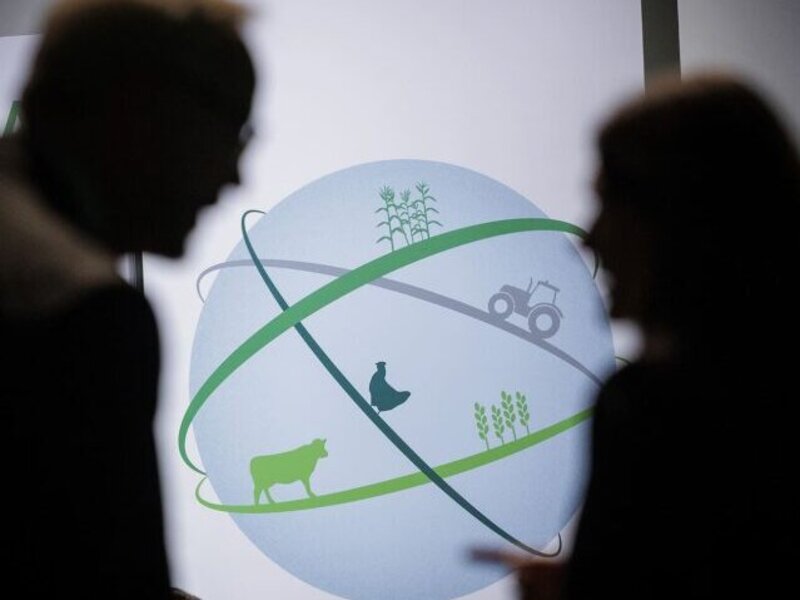
Before Green Week begins, the Global Food Forum Agriculture (GFFA) will open its doors from 14 to 17 January at the Berlin Exhibition Centre. The main theme is: Water. Harvests. Our Future. After all, a reliable supply of clean water is essential for producing sufficient food. As a result of the climate crisis, water is becoming increasingly scarce globally, but also in Germany, posing major challenges for agriculture and fisheries.
For four days, participants from research, politics and practice will discuss at the GFFA how water can be used sustainably and thus global food security strengthened. The Thünen Institute is organising two expert panels with keynote speeches and open discussion rounds on the role of aquaculture and water governance.
Panel 1: Aquaculture between water scarcity and growing demand
Aquaculture is the fastest growing sector of food production worldwide and already makes an important contribution to the global supply of fish and seafood. In recent decades, the sector has diversified and now uses different production systems depending on the type of organism, from algae to fish. The cultivation of algae and mussels, for example, as well as traditional pond systems such as those used for carp farming, are particularly resource-efficient. In addition, aquaculture can contribute to species conservation and improve the quality of habitats.
Against this backdrop, a panel discussion organised by the Thünen Institute of Fisheries Ecology will take place on 15 January during the GFFA on the role of aquaculture in sustainable water use and strengthening the blue bioeconomy. In his keynote speech, aquaculture and fisheries expert Prof. Dr Manuel Barange, Assistant Director-General of the FAO, will assess current global developments in aquaculture.
The panel guests will then discuss how aquaculture can adapt to increasing water scarcity, contribute to water resilience and at the same time provide high-quality animal protein for a growing world population. The focus will be on technological innovations such as modern recirculation systems and the potential of algae and mussel farming to improve water quality. As a scientist at the interface of ecology, aquaculture and resource conservation, Prof. Dr. Reinhold Hanel, Director of the Thünen Institute of Fisheries Ecology, will moderate the discussion.
The following experts will participate in the panel discussion:
- Julián García Baena from the European Commission will show how innovations in aquaculture can be implemented in practice.
- Yas Farjad, Policy Officer at the French Ministry of Fisheries and the Sea. She will focus on nature-based solutions and explain how algae and mussel farming can contribute to improving water quality.
- Prof. Dr Béla Urbányi, Professor at the Hungarian University of Agriculture and Life Sciences and a renowned expert in traditional and modern pond farming. He will highlight the lessons that can be learned from historical aquaculture systems.
Panel 2: Effective water governance for global food security
Water governance determines at the political and legal level who decides how water is used, protected and made more readily available in the future. On 16 January, four international experts from the fields of agriculture and environmental policy will discuss how a transformation of water governance can be implemented and what role international cooperation should play in this process.
The expert panel is organised by the Coordination Unit Climate, Soil, Biodiversity of the Thünen Institute and the International Food Policy Research Institute (IFPRI). It will be moderated by Thünen scientist Dr Claudia Heidecke, an expert in agricultural water management and international agricultural climate policy.
The invited guests are:
- Dr Claudia Ringler, Director for Natural Resources and Resilience at IFPRI. She will contribute her research experience in the field of groundwater governance in Africa and India.
- Prof. Dr Ines Dombrowsky, Head of the Environmental Governance Research Department at the German Institute for Development and Sustainability (IDOS). She will share her insights into the challenges and transformation pathways for water governance in the Middle East, Central and East Asia.
- Dr Nataliya Stupak, researcher in the Coordination Unit Climate, Soil, Biodiversity at the Thünen Institute. The researcher represents the perspective of Europe and Germany on water management and water governance issues.
- Jean Boroto, Senior Officer at the Food and Agriculture Organization of the United Nations (FAO). He reports on FAO activities in the field of water governance and on regional initiatives and approaches in the Global South.