Braunschweig (22 October 2025). The Nexus Report of the World Biodiversity Council (Intergovernmental Science-Policy Platform on Biodiversity and Ecosystem Services, IPBES) has been published. With an assessment of more than 70 options for action, the current work reaches an unprecedented scale, making it one of the most ambitious reports ever produced by the IPBES community.
The Nexus Report is the first of its kind to address and assess the links between biodiversity loss, water quality and availability, food security and health, and resilience to the impacts of climate change. More than half of the world's population already lives in regions affected by all of these negative impacts. The authors highlight how closely these global crises are interlinked and how they can be better addressed by making decisions that transcend previously separate issues. They argue that integrated and adaptive decisions should be made a maxim of policy. One example of such global interdependencies is the worldwide decline in biodiversity in agricultural landscapes caused by the intensification and specialisation of agriculture. This is characterised by the loss of wild species, natural habitats and genetic resources, for example in seeds or animal breeds. This type of agriculture produces less healthy food and compromises food security. According to the Nexus report, this not only weakens the vitality of agricultural ecosystems, but also the resilience of food systems to extreme weather, pest infestations and other disruptions. In addition, social systems that provide employment and health care, or economic systems that generate income and productivity, can lose their strength. "If we continue to make isolated decisions about individual nexus elements, our planet's vital stress limits will be exceeded. The nexus elements are inextricably linked, so rapid rethinking and integrated action are essential to bring about the urgently needed changes that will have a positive impact on nature and people," says Diana Sietz of the Thünen Institute of Biodiversity, one of the nominated lead authors of the Nexus Report. She and Christian Levers, as contributing authors, have contributed scientific expertise in the research areas of agroecology, socio-ecological systems and transformative change to the Nexus Report.
A total of 165 scientists from around the world contributed to the current report. The report provides political decision-makers with a sound scientific assessment of the interlinked crises and outlines possible ways of overcoming them.
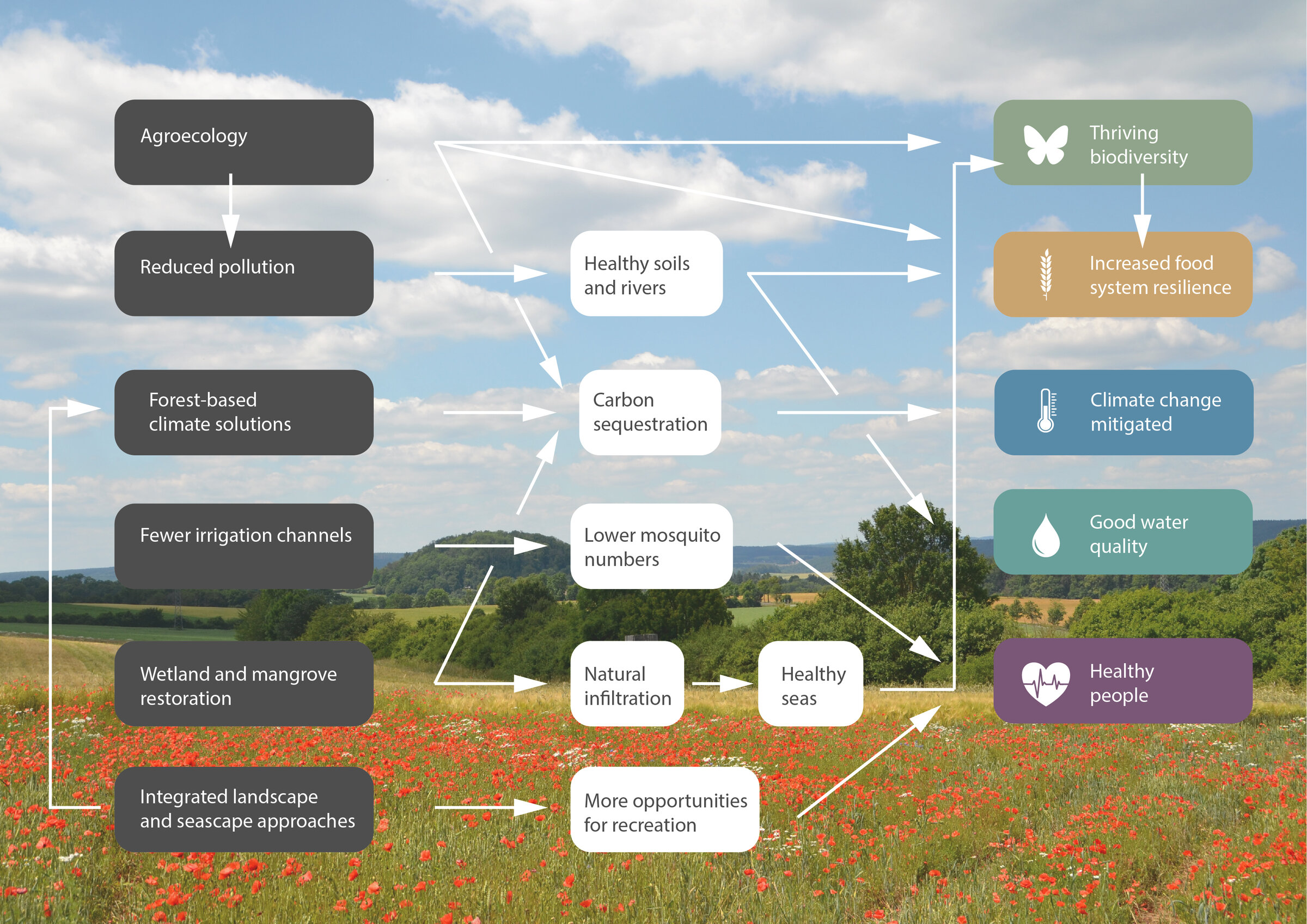
The more than 70 options for action assessed by the experts were grouped into ten categories, each of which comprises a broad spectrum of effective measures. Examples of these categories, which have largely positive effects on all nexus elements, include:
- integrated management of landscapes and marine areas that protects biodiversity, preserves habitats and does not pollute the climate, water or air;
- biodiversity management to reduce the risk of disease transmission from animals to humans;
- restoration of carbon-rich ecosystems such as forests, soils and mangroves,
- support for indigenous knowledge and food systems.
The options for action at political, societal and municipal level outlined in the Nexus Report are already available today, some at reasonable cost and with rapid effect.
About IPBES
The Intergovernmental Science-Policy Platform on Biodiversity and Ecosystem Services (IPBES), with more than 150 member states, assesses the state of biodiversity and ecosystem functions at the request of governments and other decision-makers. Based on this, it identifies options for action and politically relevant instruments that can help to formulate and implement targeted policy measures. IPBES thus aims to support political decision-making processes with scientifically sound, independent and legitimate information in order to use biodiversity sustainably and ensure the long-term well-being of people.