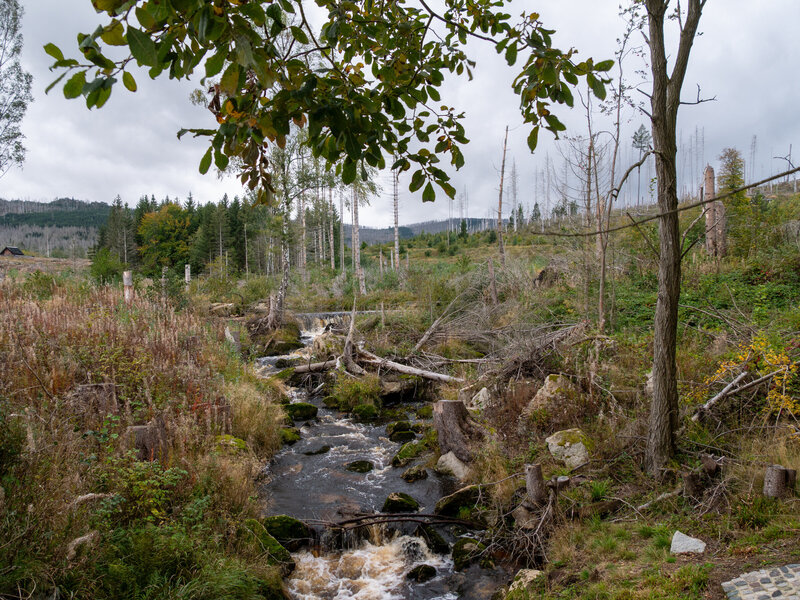
The forest management of the future is being developed in the Harz Mountains and Lower Bavaria. Three so-called Forest Living Labs – forests in which data is collected and experience gained under real-time conditions – are currently being established there. The aim is to develop new management approaches for the severely damaged and vulnerable spruce locations in the German low mountain ranges on representative areas and to optimise natural climate protection in the forest ecosystems. The data collected in the Living Labs will be synthesised, regionalised and projected using remote sensing and models. At the same time a long-term Germany-wide implementation of the approach will be tested.
The Forest Living Labs form the central starting point of the new research-practice network SURVEY, which is coordinated by the Thünen Institute of Forest Ecosystems and the Helmholtz Centre for Environmental Research (UFZ). The Julius Kühn Institute (JKI), the Northwest German Forest Research Institute, the Forest Research and Competence Centre Gotha/ThüringenForst, the Ludwig Maximilian University and the Technical University of Munich as well as the Technical University of Dresden are involved as project partners. For the first time, three areas are being researched according to a standardised model and all forest stakeholders are involved. One of the almost bare forest areas will be left to its own devices, another will be reforested in the traditional way, and a third will be planted with tree species that, according to current knowledge, should be particularly resistant to changing climatic conditions. Digital twins of the plots will be created so that the results obtained can be verified directly. The results obtained locally will be transferred to larger forest areas with the help of remote sensing, artificial intelligence methods and other geodata such as digital soil and location data. This allows the data to be extrapolated to a supra-regional model for forests in the low mountain range, which are characterised by spruce and are therefore very susceptible to damage.
For project manager Andreas Bolte from the Thünen Institute of Forest Ecosystems, one of the key aspects of the new Forest Living Labs is that central stakeholder groups related to the forest are involved in all processes. As in the REGULUS research programme, which links forest and wood research throughout Germany, science and practice will also work hand in hand in the SURVEY project. "Forests are part of society. Foresters, conservationists and other carers cannot save the forests alone. Only society as a whole can do that” says the forest ecologist.
UFZ remote sensing expert Daniel Doktor from the project management team emphasises the interdisciplinary approach of the project: "For the first time, we are combining traditional forestry observations with remote sensing monitoring, AI methods and model-based simulations. This means that the new dynamic changes in the forest ecosystem can be recognised more quickly and its future state can be projected." Governance research is also part of the project: the researchers want to improve the long-term networking of forest and timber research and to define what the legal framework for sustainable forest management could look like.
The project, which is funded by the Federal Ministry of Research, Technology and Space (BMFTR) via the project management organisation PTJ, was launched on 1 June 2025 and will run for three years. The aim is to continue the established Forest Living Labs beyond this period.
Cluster of excellence at the University of Freiburg on forests of the future
The expertise of forest researchers at the Thünen Institute will in future also be incorporated into the research of the new Future Forests Cluster of Excellence at the University of Freiburg. Forests of the future are viewed there as socio-ecological systems. The transformation pathways developed in the cluster should be transferable worldwide and to various ecosystem services. The experts involved include Prof. Andreas Bolte, Prof. Matthias Dieter and Dr. Nicole Wellbrock from the Thünen Institute.