![[Translate to English:]](/media/_processed_/6/1/csm_AdobeStock_543466681_9df3d40718.jpeg "[Translate to English:]")
![[Translate to English:]](/media/_processed_/6/1/csm_AdobeStock_543466681_6eab1c26f9.jpeg "[Translate to English:]")
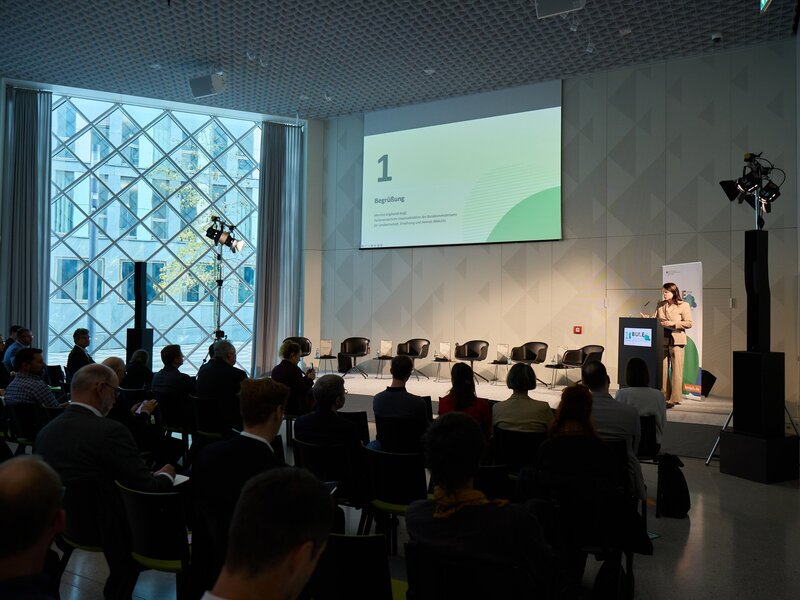
Municipalities are key actors in implementing the energy transition and serve as the first point of contact for citizens and businesses. The event series “Municipalities in Dialogue: Actively Shaping the Energy Transition” hosted by the Federal Ministry of Agriculture, Food and and Regional Identity (BMLEH) brings stakeholders together and provides a platform for exchanging experiences on the opportunities and challenges of the energy transition. Funded through the Federal Office of Agriculture and Food, the series concluded with a formal closing event in Berlin on 4 November 2025. Around 60 guests attended in person, while more than 150 participants joined online.
Following the welcome address and opening remarks by Martina Englhardt-Kopf, Parliamentary State Secretary to the Federal Minister of Agriculture, Food and and Regional Identity, Dominik Frankenberg delivered a keynote analyzing regional disparities in renewable electricity generation. His presentation highlighted that the associated municipal value-creation potential is particularly concentrated in structurally weak rural regions. In this context, municipal revenue participation through trade tax as well as special levies based on Section 6 of the Renewable Energy Sources Act (EEG) plays a key role. Frankenberg provided an in-depth discussion of the opportunities and challenges arising from municipal revenue participation and outlined key success factors for achieving the expansion targets.
Additional program elements—such as interactive thematic tables and a gallery walk showcasing six municipal projects that presented practical solutions for the energy transition—offered participants the opportunity to gain hands-on insights into supported initiatives and engage directly with experts and project leads.
Further information (event website): https://buleplus-energiewende.de/event/abschlussveranstaltung/
Contact: Dr. Dominik Frankenberg