


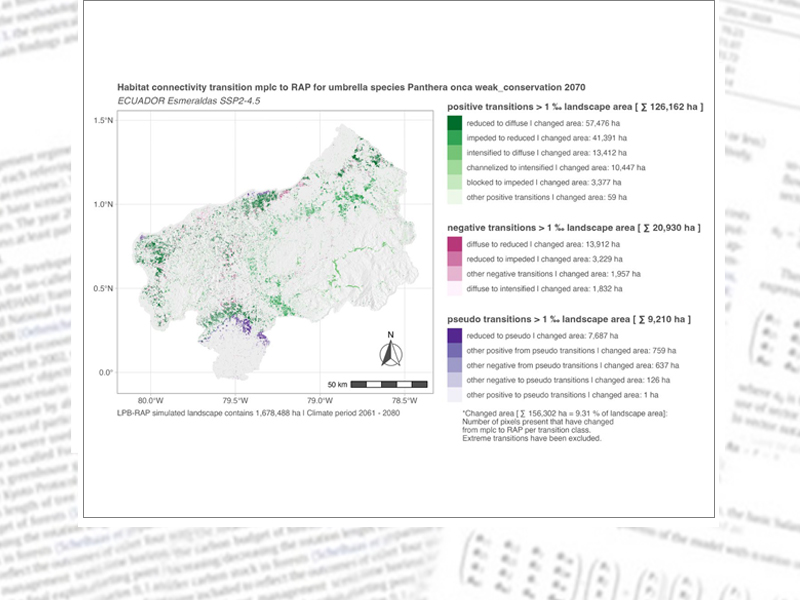
One strategy to address these challenges is to use wild umbrella species as proxies to guide policy development and to support landscape planning in the long term.
Forest and Landscape Restoration (FLR) aims to promote both ecological sustainability and human well-being. However, the long-term effects on umbrella species and their movement potential have not been sufficiently studied. To address this research gap, the dynamic and spatially-explicit LPB-RAP model (Holler et al., 2024) was extended with circuit theory-based methods to analyse potential future habitats.
The Ecuadorian province of Esmeraldas was used as a case study, with the jaguar (Panthera onca) serving as an umbrella species. The simulation extended from 2018 to 2100 under an annual and per-hectare resolution using a SSP2-RCP4.5 scenario setting.
Modelling results suggest that an agroforestry-based FLR scenario - which aims to increase forest cover while benefiting both ecosystems and local communities - would only marginally improve the movement potential for female jaguars. This limited impact is primarily due to the fact that female jaguars strongly avoid areas disturbed by humans. To meaningfully improve habitat connectivity and movement potential in the face of ongoing habitat fragmentation and loss, additional measures such as the establishment of habitat corridors are needed. (Published under a Creative Commons license.)
- Holler S, Hall KR, Rayfield B, Zapata-Ríos G, Kübler D, Conrad O, Schmitz O, Bonannella C, Hengl T, Böhner J, Günter S, Lippe M (2025) Ubi es, room to roam? Extension of the LPB-RAP model capabilities for potential habitat analysis. Ecol Model 501:111005, DOI:10.1016/j.ecolmodel.2024.111005
https://literatur.thuenen.de/digbib_extern/dn069366.pdf
- Project
LaForeT - Landscape Forestry in the Tropics: REDD+ und Restoration