


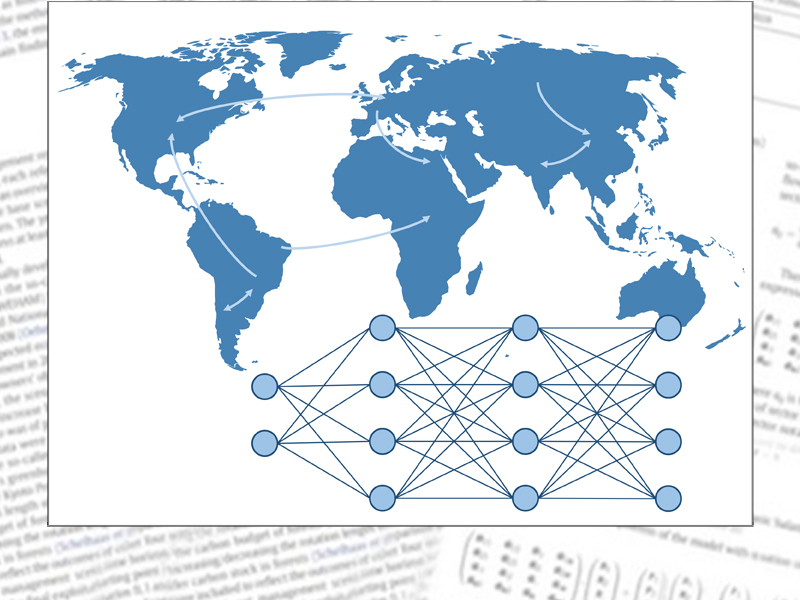
the deterministic Gravity model and an artificial neural network (Feedforward Neuronal Networks, FFNN). The aim is to compare the accuracy of both approaches to determine which model is better suited for predicting existing trade flows and forecasting future developments.
Key results:
- FFNN outperformed the Gravity model in predicting past and present trade flows across all product categories studied.
- FFNN's superiority in forecasting diminishes as the forecast horizon increases.
Our results highlight that both approaches are suitable for different analytical purposes. The FFNN might be better suited for short-term predictions, while the Gravity model remains a robust tool for long-term analyses.
Morland C, Tandetzki J, Schier F (2025) An evaluation of gravity models and artificial neuronal networks on bilateral trade flows in wood markets. Forest Pol Econ 172:103457, DOI:10.1016/j.forpol.2025.103457
https://literatur.thuenen.de/digbib_extern/dn069575.pdf