![[Translate to English:]](/media/_processed_/9/2/csm_Allgemein_Thueringen_Hainich_Mischwald_Bolte_2__19d9dab56a.jpg "[Translate to English:]")
![[Translate to English:]](/media/_processed_/d/2/csm_100_0001_0013_c05c63e7db.jpg "[Translate to English:]")
Publications & Projects
Here you will find interesting publications on current topics, research results, theses and information on ongoing projects at the Britz intensive monitoring site.
2025: Bad starting conditions for the forest
An exceptionally dry spring is affecting the forests: Only a quarter of the usual precipitation has fallen on our intensive monitoring area in Britz since March. The result: poor growing conditions and hardly any new groundwater formation
From the beginning of March to the end of May, it only rained 35 millimetres this year at the forest hydrology test site in Britz. That is a quarter of the average precipitation compared to the same months in the years 1993 to 2022. In January, the precipitation was still above average, then it leveled off. So far this year, it has only rained 140 millimetres. This is the second-lowest figure since 1993. Only in 2003 was it slightly drier from January to May, with only 139 millimetres of precipitation.
In contrast to the wet winter half-year 2023/2024, the starting conditions for forest vegetation are therefore poor this year. The landscape water balance also suffers because little or no new groundwater is formed due to the drought and the vegetation empties the soil water reservoir.
You can find the full article here:
2024: Good conditions for spring budding in the forest
There has not been this much rain in winter since the series of measurements began in 1993. The best conditions for plants to emerge in spring.
In recent months, it has not only felt like it has rained a lot - this winter has set a new record: For 30 years, precipitation and seepage have been measured alongside other parameters at the forest hydrology test site in Britz near Eberswalde. With 311 millimeters (mm) of rain and snow measured, there was more water than ever before since the time series began. The amount of precipitation is good news for the upcoming growing season. This is because winter precipitation is important for moistening the soil and creates good starting conditions for the plants to sprout in spring.
You can find the full article here:
2024: Good condition for spring budburst
2022:Information on the storm damage in the Britz intensive monitoring area
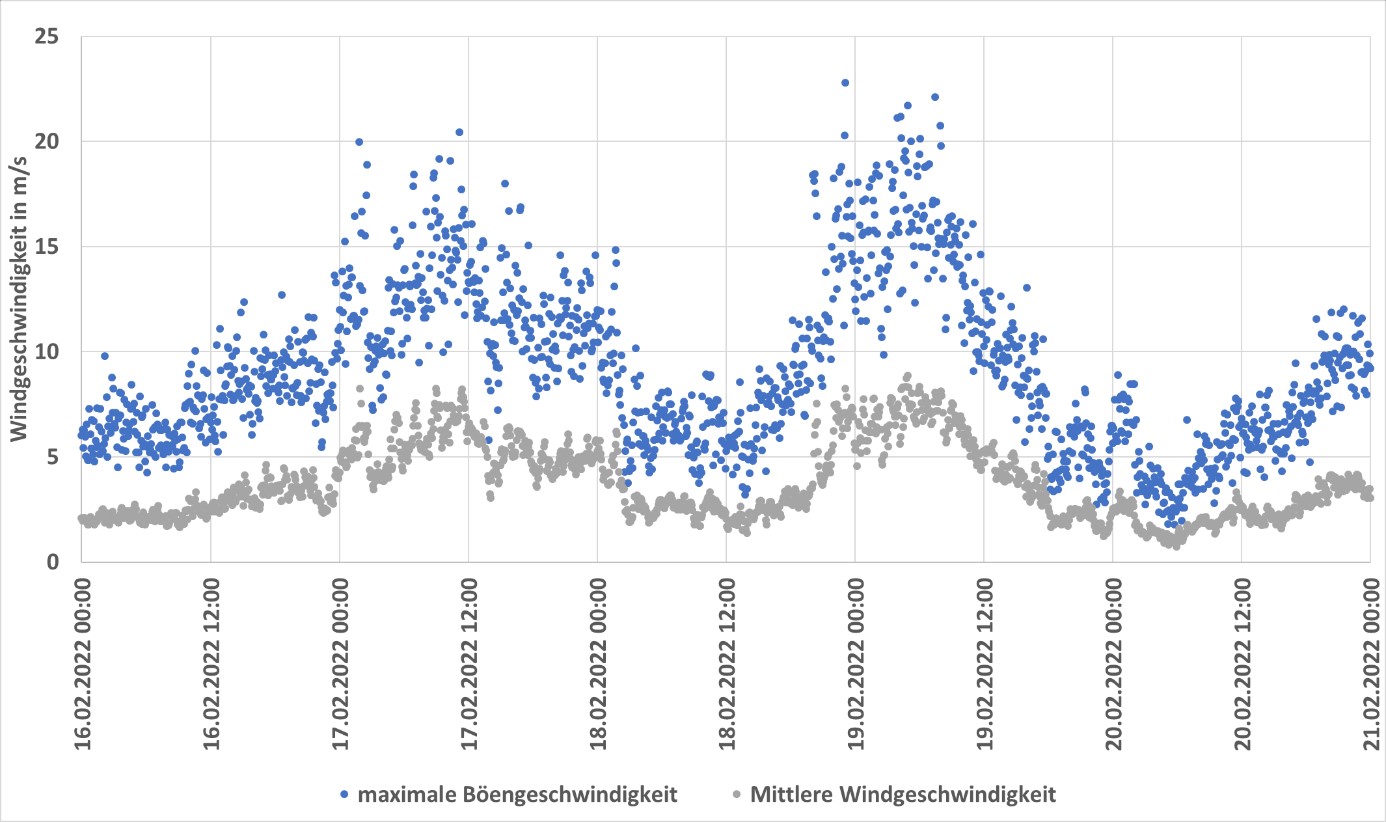
Between February 17 and 19, 2022, stormy conditions also prevailed in north-eastern Germany due to the passage of the storm lows "Ylenia" and "Zeynep". With comparatively low wind speeds of between 80 and 90 km/h, the two storms hit the Britz intensive monitoring area and caused storm damage to several trees. These affected both the approximately 50-year-old Douglas fir and the pine stand, as well as older pines in the buffer area of the lysimeter station. They include various forms of damage. Several trees were uprooted and both trunk breakage at breast height and crown breakage occurred. Among the affected trees are also measuring trees that were equipped with dendrometers for circumference measurement. Just a few weeks earlier, the trees at the test station had had to withstand the storm "Nadia". At that time, only a few Douglas firs fell victim to the storm.
In the "WinMol" project, we dealt with storm damage, further information can be found here:
Projectbrief 2024/08
Die temperaturausgleichende Wirkung von Waldbeständen am Beispeil der Intensivmonitoringfläche Britz
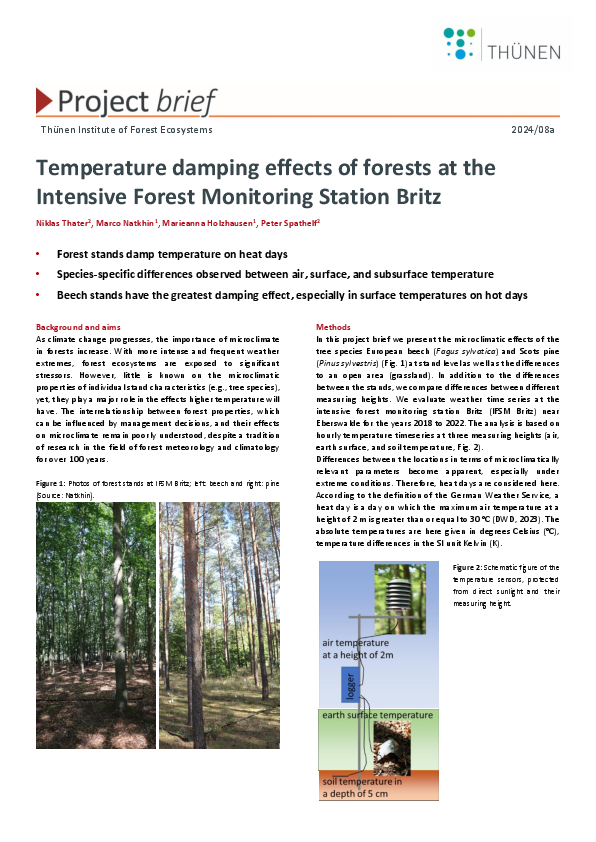
Download: Projectbrief 2024/08
Poster on the Britz intensive monitoring area
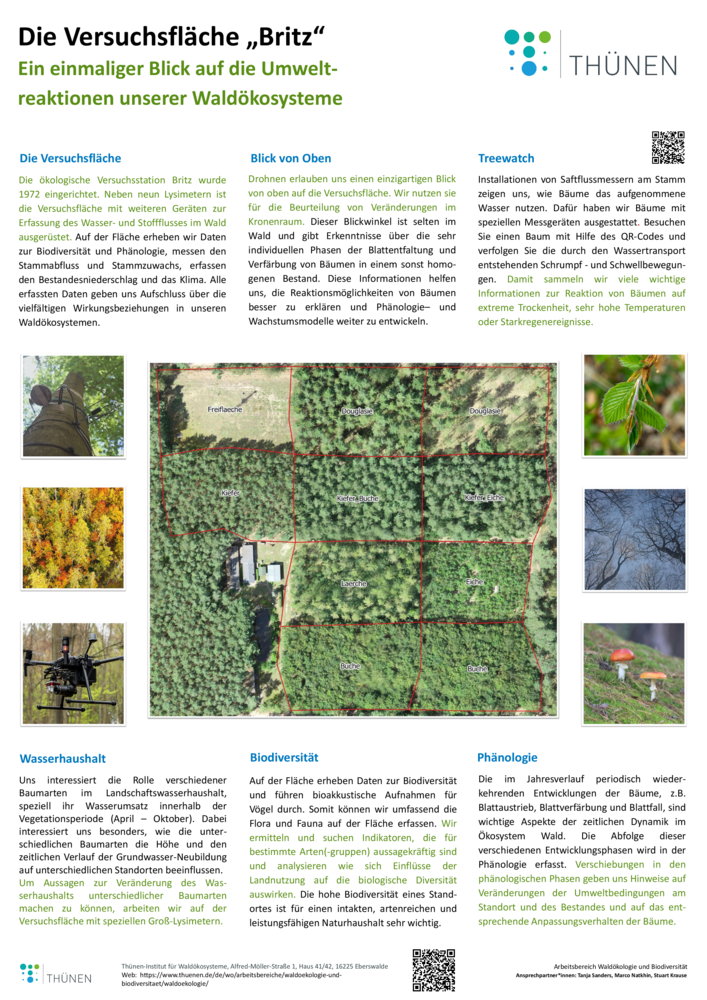
Download Poster Britz (only in german)