![[Translate to English:]](/media/_processed_/6/4/csm_titel_CO2Kampagne8_afeea2273e.png "[Translate to English:]")
![[Translate to English:]](/media/_processed_/4/1/csm_titel_93px_CO2Kampagne8_9b0f3354d4.png "[Translate to English:]")
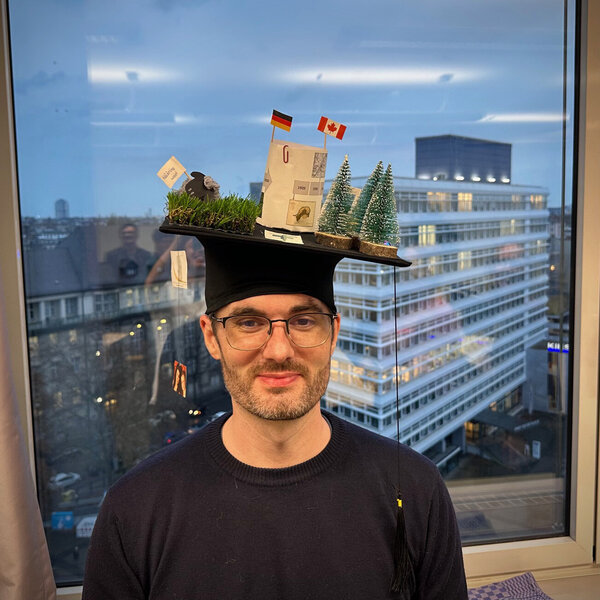
On 10 December 2025, David Emde successfully defended his doctoral thesis at Technische Universität Berlin. As part of the EJPSoil project, he investigated how land-use changes affect soil organic matter. The dissertation was supervised by Dr Florian Schneider (Thünen Institute of Climate-Smart Agriculture) and Prof. Dr Carsten W. Müller (TU Berlin).
For his analyses, David Emde used data from the national soil inventories in forestry and agriculture and complemented these with site-specific time series of historical land use. Through extensive research in nationwide digital archives - particularly the SLUB Dresden - and in the geoportals of the individual federal states, historical land-use maps were evaluated for all sites of the German Agricultural Soil Inventory. This made it possible to reconstruct land use and its changes over the past century and, in some cases, beyond. The availability of historical cartographic material varied regionally: near Braunschweig, for example, survey maps from the Prussian Land Survey (scale 1:25,000) enabled the determination of land use at the beginning of the 20th century, with further updates at intervals of several decades.
Based on these time series, David Emde classified the sites according to their land-use history into continuous cropland or grassland, a single historical conversion (cropland → grassland or vice versa), and multiple transitions between cropland and grassland. Subsequent analyses showed that soil texture - whether clayey, sandy, or silty - played only a minor role. Instead, hydrological site conditions and topography were decisive: the wetter and/or steeper the terrain, the more likely permanent grassland or a historical conversion from cropland to grassland, irrespective of a soil’s particle size distribution. These relationships were quantified using models to estimate the probability of each land-use class.
In the next step, David Emde used statistical methods to determine the effects of land-use change on soil carbon stocks. The results indicate extremely long-term impacts: according to Emde et al. (2024), soil organic carbon stocks require around 80 years to reach a new equilibrium after conversion from cropland to permanent grassland; the reverse conversion (grassland → cropland) may take up to 180 years. This highlights the importance of land-use history for interpreting current soil carbon trends.
Another key finding concerns changes in soil carbon stocks at different depths: land-use change affects not only the upper 30 cm of soil but also deeper horizons. Estimates indicate that approximately 30% of land-use-change-induced changes in soil carbon stocks occur at depths greater than 30 cm. In transitions between grassland and forest, the organic litter layer compensates for most carbon changes in the mineral soil.
In conclusion, site-specific baseline soil carbon stocks largely determine the magnitude of absolute organic carbon changes (t ha⁻¹): soils with high initial carbon stocks exhibit greater absolute carbon losses or gains following land-use change.
Conclusion: Land-use changes have longer-lasting and stronger effects on soil carbon stocks than previously thought - an essential consideration for climate and agricultural policy.