![[Translate to English:]](/media/_processed_/6/4/csm_titel_CO2Kampagne8_afeea2273e.png "[Translate to English:]")
![[Translate to English:]](/media/_processed_/4/1/csm_titel_93px_CO2Kampagne8_9b0f3354d4.png "[Translate to English:]")
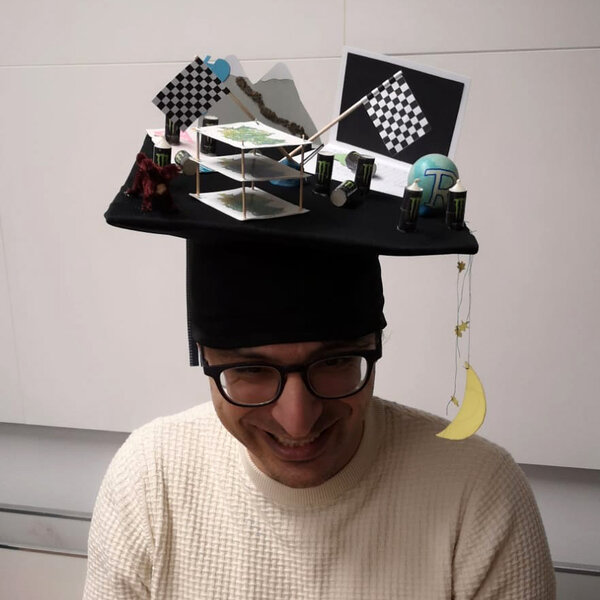
Ali Sakhaee successfully defended his doctoral thesis entitled “Spatial Prediction of Organic Matter in German Agricultural Soil with Machine Learning” at the University of Tübingen on November 25th, 2025. The dissertation was written as part of the SoilSpace3D project and supervised by Prof. Dr. Axel Don (Thünen AK) and Prof. Dr. Thomas Scholten (University of Tübingen). SoilSpace3D was a joint project with the German Research Centre for Environmental Sciences (UFZ) (Dr. Mareike Ließ). His research topic was the spatial modeling of organic soil matter on a Germany-wide scale in agricultural soils. To this end, he used AI-based machine learning methods and developed them further.
In his dissertation, Ali Sakhaee investigated the following research questions:
- How can the model quality for spatial soil carbon modeling be improved, e.g., by expanding the sample size or stratifying the data set?
- Which machine learning algorithms achieve the highest prediction accuracy?
- How well can the quality of organic soil matter be predicted on a national scale, in addition to its quantity?
- What are the underlying factors and processes responsible for the variability in the quality of organic soil matter?
- Which methods are best suited to modeling not only the two-dimensional spatial distribution of soil carbon but also the third dimension, i.e., its distribution at different depths?
These questions aim at a fundamental methodological understanding and further development of pedometric methods for digital soil mapping. The spatial modeling of soil carbon was based on data from the Agricultural Soil Inventory.
Ali Sakhaee's work has produced maps that are also used in other areas of research and application and have been directly incorporated into the national reporting on greenhouse gas emissions in the LULUCF sector, which is produced by the Thünen Institute of Climate-Smart Agriculture. In his doctoral thesis, he explored the potential of AI for creating soil maps and further developed methods, thereby making an important contribution to a rapidly evolving field of research.