![[Translate to English:]](/media/_processed_/d/7/csm_Startseite-OF_03_c0dfd6e750.png "[Translate to English:]")
![[Translate to English:]](/media/_processed_/a/3/csm_20181116-151457-Stella-Jerome-Fischfalle-Warnem%C3%BCnde-Dorsche-im-Netzk%C3%A4fig-5691_heller_3050c72fa2.png "[Translate to English:]")
Project
Does the efficiency of PAL to reduce harbor porpoise bycatch persist?
![[Translate to English:]](/media/_processed_/a/c/csm_S0151207-Schweinswale_d760544e05.jpg)
PAL use in German waters - Current efficiency and mode of operation
This project investigated whether the effect of PAL devices, which fishers in Schleswig-Holstein have been voluntarily attaching to their set nets since 2017 to avoid harbor porpoise bycatch, persists over long periods of time.
Background and Objective
Special warning devices (Porpoise ALert, PAL) that reduce the bycatch of harbor porpoises (Phocoena phocoena) in set nets have been used by fishers in Schleswig-Holstein on a voluntary basis since 2017. However, it is unclear whether the effect of the PAL, as demonstrated by the Thünen Institute of Baltic Sea Fisheries, persists over long periods of time, or whether it might diminish as harbor porpoises become accustomed to the warning signals. The third-party funded project "PAL use in German waters - Current efficiency and mode of operation" (PAL-CE), led by the Deutsches Meeresmuseum Stralsund and funded by the Federan Agency for Nature Conservation (Bundesamt für Naturschutz), contributed to clarifying these questions; it run from 2022 to the end of June 2025. Additional partners to this project were the Thünen Institute of Baltic Sea Fisheries (project leader Dr. C. von Dorrien), the Aarhus University (Denmark) and the Ostsee Info Center Eckernförde (Germany).
Approach
While the Deutsches Meeresmuseum experimentally studied the reaction of harbor porpoises to the PAL, one of the activities of the Thünen Institute of Baltic Sea Fisheries was to record potential acoustic reactions of harbour porpoise to PAL that were attached to the set nets of comercial fishermen over long time periods off the coasts of Schleswig-Holstein and Denmark.
Data and Methods
Harbour porpoises are particularly challenging to observe due to their small size and inconspicuous behaviour. To better understand their behaviour, efficient observation tools are required. The theodolite and the drone are two land-based observation methods commonly employed to observe small cetaceans with near shore distribution.
Drones with video cameras were used to study in more detail the behaviour of porpoises near a bottom set net structure with and without PAL during a targeted experiment in Fyns Hoved (Denmark). These trials were designed to enhance our understanding on underlying behavioural mechanisms leading to entanglement in set bottom nets as well as behavioural reactions of porpoises towards a net equipped with PAL. For this, wild harbour porpoises were recorded with drones and acoustic underwater recorders near a bottom set net structure during an in situ experiment in the Danish Belt Sea and different aspects of their behaviour studied: swimming speed, respiration rates, reaction types towards the net and the PAL and apparent reaction distances.
To further investigate whether porpoises in Germany might have habituated to the PAL signal since its first implementation in 2017, a long-term experiment was set up in collaboration with some fishers in Germany and Denmark to record the porpoises’ echolocation behaviour near nets with PAL. For this aim, two areas inhabited by animals from the Belt Sea population were selected as the PAL signal is a synthetic porpoise sound from this population and has this far only been successfully tested in this area. As PAL is not employed in the fishery in Denmark, the experiment was conducted under the assumption that porpoises in Denmark are more naïve to the PAL signal, thus considering Denmark as a not-exposed area. To test whether porpoises habituated to PAL in Germany, the echolocation of porpoises on reference stations without PAL and near PAL-equipped nets was compared within Germany and Denmark and between the countries. Four parameters that describe the porpoises’ click trains were selected for this aim and investigated using traditional statistics as well as machine learning models: number of clicks within a click train, the median frequency, the average sound level and the minimum inter click interval of a click train.
Advantages and disadvantages of both land-based observation tools theodolite and drones were analyzed while studying the harbour porpoise. For this aim, data on their location, behaviour and group sizes of porpoises was collected and compared between methods during the field experiments in Fyns Hoved (Denmark).
Results
Porpoises demonstrated limited behavioral responses when navigating the net, with the most common reaction being swimming over the float line without any apparent reaction, both in the presence and absence of PAL. Porpoises exhibited a consistent pattern of swimming speed, increasing the speed in direct vicinity of the net and slowing down after interacting with the net. This pattern was observed both when only the net was present as well as when the PAL was attached. The echolocation behaviour of the porpoises showed some significant differences when the PAL was present.
The median values for all four acoustic parameters describing the porpoises’ click trains were very similar, both between the reference stations of both countries and between reference stations and PAL-equipped nets within countries. Based on the four selected click train parameters, habituation of German porpoises towards the PAL was not detected.
The theodolite proved to be more adept at rapidly collecting data on the general distribution of porpoises in an area and excelled at gathering data at greater distances. The accuracy of obtained positional data of porpoises at the surface was similar with both methods, but drones revealed a clear advantage in behavioural observations, as they allow recording the animals even under the water surface. Group sizes were also determined more precisely using drones.
The new findings generated in this project address several knowledge gaps associated to the study of harbour porpoises and their interaction with bottom set nets and the PAL in the Belt Sea. The interactions revealed that porpoises are able to navigate nets without getting entangled in them and that they do not exhibit a strong reaction either in behaviour, echolocation or swimming speeds when interacting with nets and the PAL. However, despite their ability to avoid nets during the trials, bycatch persists in actual fisheries which might be attributed to distraction or inexperience rather than a lack of net detectability. It is thus recommended that alerting strategies should be combined with materials enhancing the acoustic detectability of nets to further reduce the bycatch risk.
Based on previously available information of the PAL and new findings from this project, the PAL seems to be a good alternative to traditional pingers for the Belt Sea, as PAL do not exclude porpoises from their habitat, and signs of habituation to the signal were not detected in the four analyzed click train parameters. Besides these promising findings, the project should and could not yield information on whether PAL still contributes sufficiently to bycatch reduction in the German fishery. To address this question, it is suggested that a long-term bycatch monitoring scheme be implemented to ascertain whether the proven bycatch reduction effect of the PAL persists over time, given the complexity of the real fishery in the Belt Sea. This is especially relevant in light of the limited information available on German harbour porpoise bycatch rates and the fact that current estimated bycatch levels for the Belt Sea exceed sustainable bycatch thresholds.
The results obtained at the Institute for Baltic Sea Fisheries have been summarized in several scientific publications and a dissertation (Dinkel, 2025).
Thünen-Contact

Involved Thünen-Partners
Involved external Thünen-Partners
- Deutsches Meeresmuseum
(Stralsund, Deutschland) - Aarhus University
(Aarhus, Tjele, Dänemark)
Funding Body
-
Federal Agency for Nature Conservation (BfN)
(national, öffentlich)
Duration
10.2021 - 6.2025
More Information
Project status:
finished
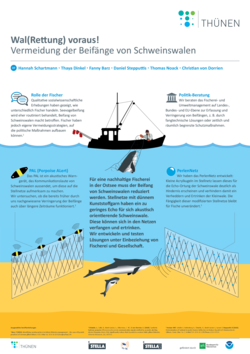
Poster: Vermeidung der Beifänge von Schweinswalen
 Poster Download (in German)
479 KB
Poster Download (in German)
479 KB
Publications
- 0
Dinkel TM (2025) Harbour porpoise behaviour near bottom set nets and acoustic bycatch mitigation devices [online]. Hamburg: SUB Hamburg Carl von Ossietzky, 148 p, University of Hamburg, Fak f Mathematik, Informatik und Naturwiss, Diss, 2025, zu finden in <https://ediss.sub.uni-hamburg.de/handle/ediss/11713> [zitiert am 12.09.2025]
- 1
Dinkel TM, Girard A, Bär T, Dähne M, Craul A-K, Cosentino M, Meyer-Klaeden O, Dahlke FT, Dorrien C von (2025) Performance of theodolites versus drones in land-based studies of marine mammals. Sci Rep 15:20302, DOI:10.1038/s41598-025-06978-8
- 2
Dinkel TM, Rostock L (2025) Training data set for PAL filter [Datenpublikation]. 1 XLSX file. Göttingen: OpenAgrar, DOI:10.3220/253-2025-43
- 3
Chladek J-C, Culik B, Kindt-Larsen L, Moesgaard Albertsen C, Dorrien C von (2020) Synthetic harbour porpoise (Phocoena phocoena) communication signals emitted by acoustic alerting device (Porpoise ALert, PAL) significantly reduce their bycatch in western Baltic gillnet fisheries. Fish Res 232:105732, DOI:10.1016/j.fishres.2020.105732