![[Translate to English:]](/media/_processed_/3/6/csm_Hintergrund-Ausschnitt1_9daaef6b89.jpeg "[Translate to English:]")
![[Translate to English:]](/media/_processed_/3/6/csm_Hintergrund-Ausschnitt1_0bd7111163.jpeg "[Translate to English:]")
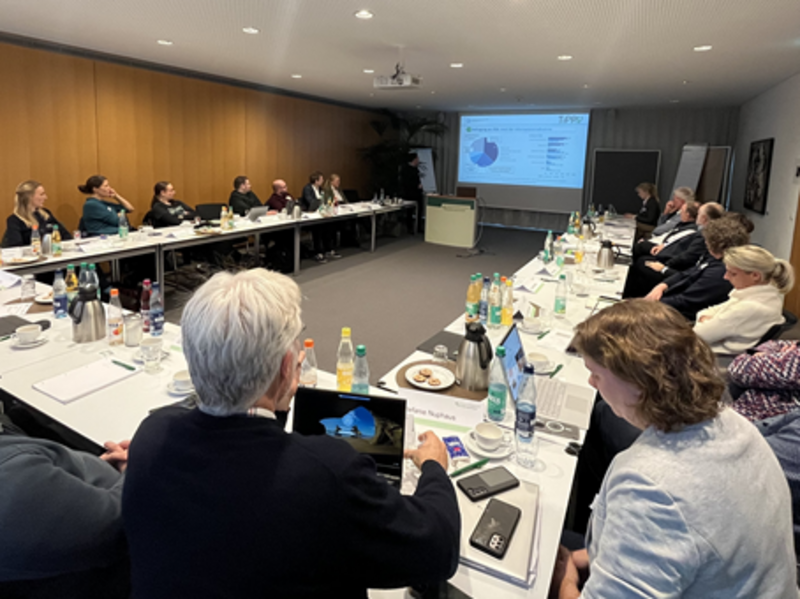
On 18th August 2025, the expert advisory board of the “TiPP – Transparency in Pig Production” project met. Coordinated by the Chamber of Agriculture of Lower Saxony and based in the Oldenburg Münsterland, the project aims to create transparency in pig farming through the use of modern technology. The board is composed of experts from science, administration, industry, and agricultural practice and provides advisory support for the project.
Focus on Transparency and Traceability
The meeting focused on “transparency” and “traceability.” Discussions centred on how the sensor data collected in the project can be processed to provide a reliable basis for assessing key aspects such as animal health, animal welfare, climate efficiency, and sustainability. The goal is to develop indices that can be applied both internally on farms and externally, for example in product labelling.
Presentation of Initial Results on Technology Use in Commercial Farms by the Thünen Institute for Agricultural Technology
The Thünen Institute for Agricultural Technology presented the first results regarding the use of climate sensors, cameras, acoustic systems, flow sensors, and optical weighing stations on pig fattening farms with different housing systems. The results include information on system failures, maintenance requirements, and data gaps, providing an initial basis to assess the robustness, reliability, and resilience of the systems used. From this, it is possible to determine which systems can be applied to increase transparency along the pork value chain and which still require improvements.
Discussion Points in the Expert Advisory Board
The board also discussed how technology use and the degree of automation on farms can be further promoted to facilitate work, increase transparency in the production chain, and ensure animal welfare. Key obstacles to adopting technology for automating and monitoring environmental conditions in barns, identified in TiPP project surveys, were high acquisition costs and low trust in the data and sensor reliability.
The discussions emphasise the importance of a transparent and scientifically grounded assessment approach. The Thünen Institute will continue to refine the sensor analysis results and develop practical recommendations. This aims to provide farmers with tools to support operational decisions while strengthening public discussion on animal welfare and sustainability on an objective data basis.
Funding
The project was funded with resources from the Federal Ministry of Agriculture, Food and Regional Identity (BMLEH) based on a decision of the German Bundestag through the Federal Office for Agriculture and Food (BLE). Funding reference number: 2822ZR013.