![[Translate to English:]](/media/_processed_/3/6/csm_Hintergrund-Ausschnitt1_9daaef6b89.jpeg "[Translate to English:]")
![[Translate to English:]](/media/_processed_/3/6/csm_Hintergrund-Ausschnitt1_0bd7111163.jpeg "[Translate to English:]")
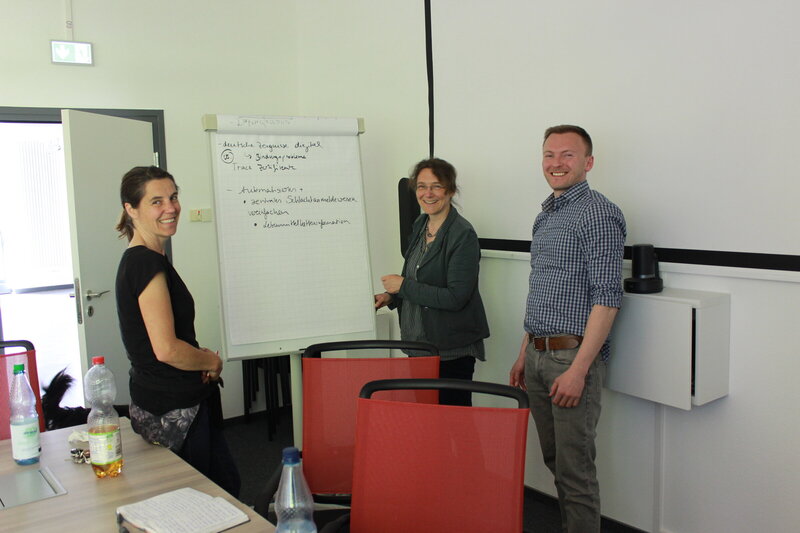
How can data exchange between farmers and control authorities become more efficient? Which digital solutions can avoid duplicate data collection? These were the topics discussed by scientists from the Future Lab Agriculture (Zukunftslabor Agrar) with stakeholders from the agricultural sector. In a joint workshop held on 16.05.2025 at the University of Vechta, the participants discussed possible solution concepts using the example of barn climate in poultry farming. A total of 12 representatives from agricultural production, veterinary offices, certification bodies, and animal welfare participated.
Agricultural poultry farms must comply with certain legal limits for barn climate. These include ammonia and carbon dioxide content in the air, as well as air temperature and humidity in the barn. The farms must check the proper functioning of their climate control daily and document this in writing. Continuous measurement and documentation are not required. Veterinary offices conduct on-site inspections at irregular intervals.
„The current practice only allows for sporadic checking of the actual barn climate during on-site inspections. This involves a significant time effort, as we found in a survey among farmers. We see great potential in sensor systems that are increasingly being used in the barn. The sensors monitor the barn climate and provide digital measurement values. These data could also be used to meet reporting and control obligations – if they were transmitted automatically and securely to the relevant control authorities. Within the framework of the Future Lab Agriculture, we have developed a solution concept for this. We discussed this concept with experts from the field in the workshop.“ – Martin Kraft
The concept describes a digital system for the collection, management, and use of barn climate data in animal husbandry. Data from existing sensors are continuously collected, centrally stored, and made available via a metadata database so that potential recipients can view available data and their properties. A consent system regulates who can use which data for what purpose and for how long. The raw data are automatically transmitted to an independent certification body or, with consent, directly to authorized bodies. There, they are evaluated and passed on in the form of demand-oriented reports to authorities or other stakeholders. The goal is transparent and standardized data use to improve animal husbandry and meet legal and qualitative requirements.
The workshop participants discussed this concept from their professional perspective. They exchanged views on the opportunities, risks, and potential obstacles of the concept. On the one hand, it became clear that there are already many digital applications and systems in agriculture. However, these are often not compatible with each other, and the necessary interfaces with authorities are missing. This frequently leads to data having to be entered multiple times, increasing the workload of farmers. On the other hand, concerns were raised regarding sensor measurements: How accurate and reliable are the sensor measurements? What happens if they fail? In addition to the measurements, further information would need to be gathered to allow valid assessment of the sensor data, e.g., the outdoor climate.
For the scientists, the feedback from animal welfare organizations and veterinary offices was particularly interesting: for monitoring the housing conditions in poultry farming, daily animal losses are mainly considered, and the barn climate can only be meaningfully evaluated in conjunction with the loss figures. Inaccuracies often occur in the recording of animal losses. There is currently no digital solution for this.
The scientists will further analyze the input of the participants regarding the solution concept and the improvement of data flows in poultry farming. Additional suggestions for digitalization needs (e.g., regarding interfaces for data exchange with control bodies or regarding the communication of veterinary offices with each other) will probably be addressed in a new research project.
The participants emphasized that the intensive exchange was very interesting and insightful. They expressed their willingness to support future research projects with their expertise to achieve a practice-oriented result.
In addition to Martin Kraft, Andrii Besieda and Prof. Dr. Christina Umstätter are involved in the research. Dr. Anne-Kathrin Schwab (University of Vechta) moderated the workshop.
Copyright 2025, Zentrum für digitale Innovationen Niedersachsen (ZDIN)