Project
Dauerco@l
Increasing yields of lignocellulosic permanent crops by and for biochar
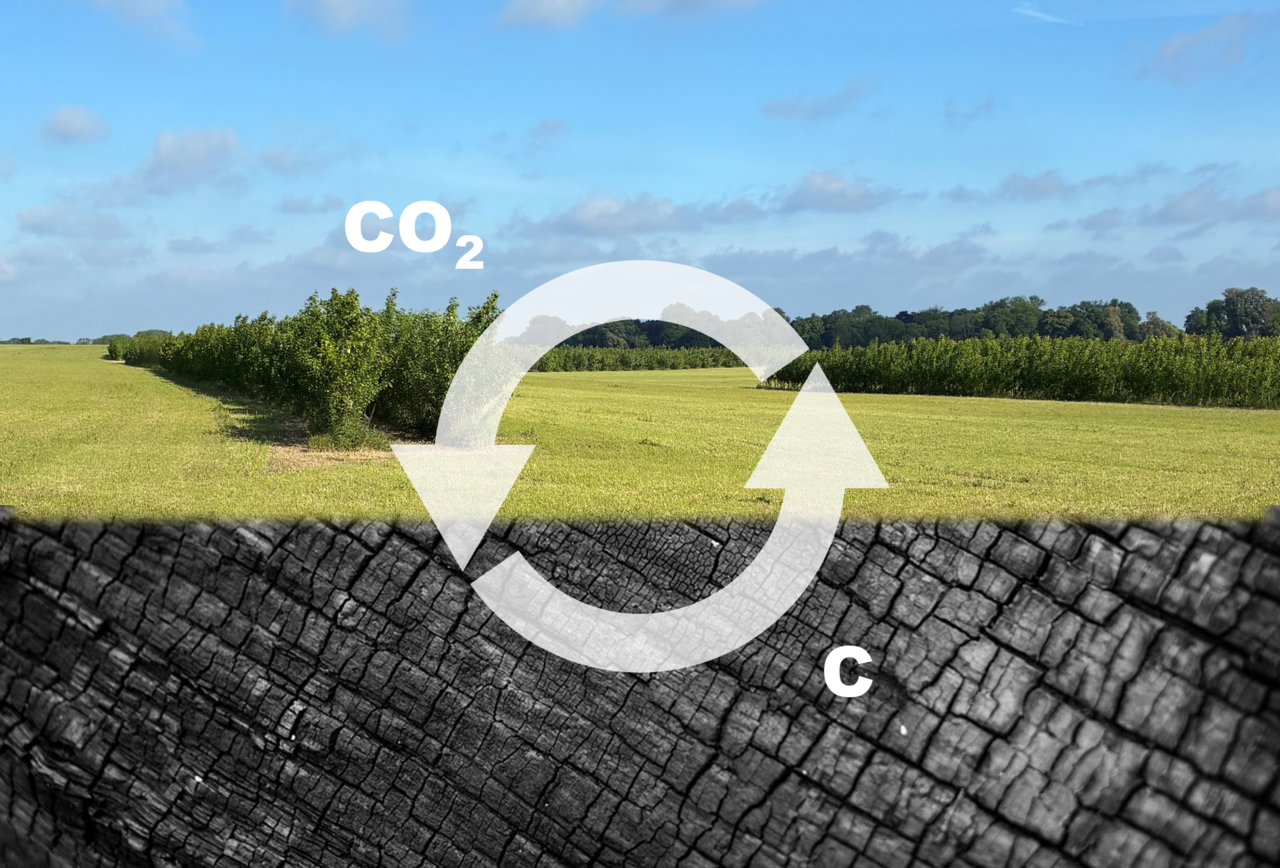
Biochar application to soils can positively influence their physical and chemical properties. Especially marginal sites can benefit from the resulting soil amelioration. In Dauerco@l, we investigate how fast-growing, lignocellulosic permanent crops (poplar short-rotation coppice) on very sandy and clayey soils can benefit from biochar application. Simultaneously, we develop an agroforestry system in which biochar is produced through the cultivation of fast-growing trees for use as a carbon sink and soil amendment, increasing yields.
Background and Objective
The positive effects of biochar application on physical and chemical soil properties are well documented. Marginal sites on the relatively young soils of Central Europe (highly sandy and clayey soils) can benefit from the application of biochar. The expected change in pore size distribution and the improvement in soil structure resulting from the application of biochar can be expected to have a positive effect on the water and nutrient balance and thus on yield. Dauerco@l focuses explicitly on the melioration effect for fast-growing poplar short-rotation coppice and examines economic issues and the climate impact of an agroforestry system optimised by biochar. Dauerco@l will provide differentiated answers to the following research questions:
- Can the application of biochar achieve effective melioration effects on sandy and clayey marginal sites, leading to a long-term yield effect when growing poplars in short rotation?
- What effects does biochar (in co-application with fertilisers and/or mineral powders) have on the physical, chemical and biological properties of sandy/clayey soils?
- Which application variants (quantity and grain size distribution of the biochar, nutrient additives) lead to which yield effects depending on the location?
- Can an agroforestry system optimised with biochar provide material for the sustainable production of biochar? In terms of economics and climate protection effectiveness, how must a regional recycling and value creation system based on this be assessed?
- Does the biochar application have long-term yield effects in lignocellulosic permanent crops that economically justify the use of biochar?
- Which conditions are necessary for the profitable use of biochar in lignocellulosic permanent crops?
- Does the agroforestry system embedded in a regional circular system have a long-term positive climate protection effect? What factors can lead to a long-term positive climate protection effect?
Approach
The central aim of Dauerco@l is the identification of an optimal, site-adapted biochar application to increase the yield of lignocellulosic permanent crops. To this end, we combine controlled experiments in the laboratory with and without plants with field trials in which the water, organic carbon and nutrient balance, as well as the stability of the biochar and its influence on the yield (above and below ground) are recorded.
Laboratory experiments relating to soil chemistry and soil biology aspects of biochar application are carried out by the Thünen Institute of Climate-Smart Agriculture. Soil hydraulic aspects will be investigated by the Department of Soil Science at the Institute of Geoecology at the Technical University of Braunschweig.
In Dauerco@l, small field trials with poplars are being set up at the sites Trenthorst (Thünen Institute of Organic Farming) and Darmstadt (Forschungsring e.V.). In these trials, different application variants (quantity and particle size of the biochar, nutrient application) will be tested on clayey (Trenthorst) and sandy (Darmstadt) marginal yield sites. The trial in Trenthorst is also part of EiLT, the experimental, interdisciplinary landscape laboratory at the Thünen Institute in the experimental field of climate-adapted trees. We will use the synergies in Thünen research on short-rotation coppices and hedges at this location.
Another focus of the project is the design of the Dauerco@l production system: a regional circular system in which biochar is produced and utilised in agroforestry systems through the cultivation of fast-growing trees. To this end, the Thünen Coordination Unit Climate, Soil and Biodiversity is designing the Dauerco@l production system and will assess its profitability, greenhouse gas balance and function as a carbon sink.
Thünen-Contact

Involved Thünen-Partners
Involved external Thünen-Partners
- Technische Universität Braunschweig
(Braunschweig, Deutschland) - Forschungsring e. V.
(Darmstadt, Deutschland)
Funding Body
-
Federal Office for Agriculture and Food (BLE)
(national, öffentlich)
Duration
1.2025 - 12.2026
More Information
Project funding number: 2823HUM010
Project status:
ongoing