![[Translate to English:]](/media/_processed_/7/1/csm_IMG_7977_large_1defaf5de1.jpg "[Translate to English:]")

Project
Exclusion of mobile bottom-fishing in the German Natura 2000 areas
Status description and monitoring concepts in protected areas for demersal fish and epifauna along gradients of different fishing intensity (MGF North Sea)
What happens to habitats and communities when commercial fishing stops? This important but largely unanswered question is the focus of this research project.
Background and Objective
In the German Exclusive Economic Zone (EEZ) of the North Sea, the three Natura 2000 areas of Sylt Outer Reef, Borkum Reef Ground and Dogger Bank are designated as nature reserves according to the EU Habitat Directive (FFH). However, this does not completely exclude commercial fishing in these areas. An exclusion of mobile bottom fishing from large parts of the three Natura 2000 areas is planned, but a final decision on the fisheries management measures in the German Natura 2000 areas by the EU Commission is still pending. The aim of this joint project is to investigate the current state of the protected goods and the ecological status of the areas in order to be able to assess the long-term effects on the prevailing habitats and communities in the protected areas after exclusion (before-after-control impact, in short: BACI approach).
Target Group
Science, politics, economy
Approach
- Detailed analysis and updating of vessel monitoring data (VMS) in order to get the most accurate picture of the distribution of fishing pressure in the Natura 2000 areas.
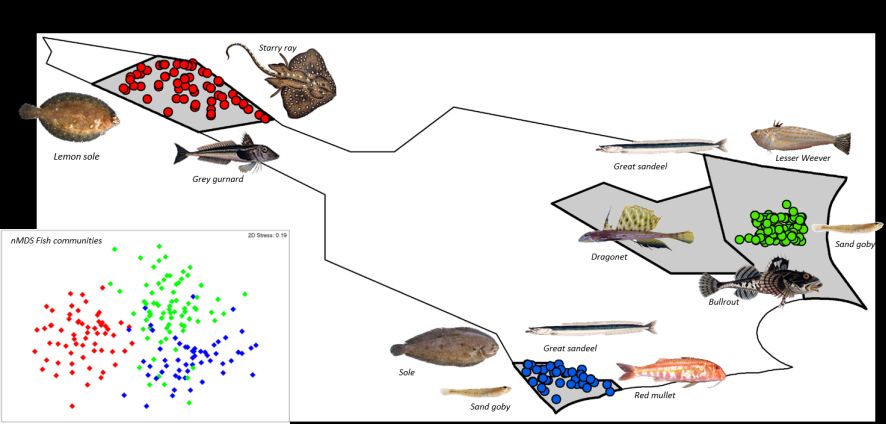
- Description of the current status of fish and epifauna communities in the Natura 2000 areas in relation to gradients in the current fishing intensity.
- Assessment of the ecological status based on the functional composition of communities and depending on the fishing gear used, fishing intensity and various environmental factors.
- Establishment of an extensive database with species-specific functional properties (“traits”) of the fish and epifauna species in order to use them for an evaluation of the effectiveness of fisheries exclusion.
- Development of a monitoring concept testing alternative methods. These will include camera systems, and environmental DNA (eDNA) analysis to survey fish and epibenthic biodiversity.
Our Research Questions
How do benthic habitats and communities in the German Natura 2000 areas react to the exclusion of mobile bottom fishing?
Preliminary Results
Project brief: Weinert M, Neumann H, Kraan C, Haslob H (2025) Development trends of marine communities in protected areas of the North Sea : baseline and tools for long-term monitoring. Bremerhaven: Thünen Institute of Sea Fisheries, 2 p, Project Brief Thünen Inst 2025/30a, DOI:10.3220/253-2025-213
Links and Downloads
 Project brief MGF NORDSEEMichael Weinert, Hermann Neumann, Casper Kraan, Holger Haslob (Project Brief 2025/30a): Development trends of marine communities in protected areas of the North Sea: baseline and tools for long-term monitoring
467 KB
Project brief MGF NORDSEEMichael Weinert, Hermann Neumann, Casper Kraan, Holger Haslob (Project Brief 2025/30a): Development trends of marine communities in protected areas of the North Sea: baseline and tools for long-term monitoring
467 KB
Thünen-Contact

Involved Thünen-Partners
Involved external Thünen-Partners
- Alfred Wegener Institut (AWI) - Helmholtz -Zentrum für Polar und Meeresforschung
(Bremerhaven, List (Sylt), Deutschland) -
Helmholtz-Zentrum Hereon (alt: Helmholtz-Zentrum Geesthacht)
(Geesthacht, Deutschland) -
Carl von Ossietzky Universität Oldenburg
(Oldenburg, Deutschland) -
Senckenberg Gesellschaft für Naturforschung
(Frankfurt, Wilhelmshaven, Görlitz, Deutschland)
Funding Body
-
Federal Ministry of Research, Technology and Space (BMFTR)
(national, öffentlich)
Duration
3.2020 - 2.2026
More Information
Project funding number: Förderkennzeichen: 03F0847C + Förderkennzeichen: 03F0936E
Project status:
ongoing


Publications
- 0
Gwinner M, Haslob H, Neumann H, Khodami S, Schupp PJ, Bonthond G (2026) Flatfish intestinal microbiota depend on various host traits, and vary with sediment type and bottom trawling effort. Sci Rep 16:632, DOI:10.1038/s41598-025-34195-w
- 1
Fricke TY, Neumann H, Haslob H, Meyer C (2025) Automatic detection of common starfish Asterias rubens in North Sea underwater images. In: Homann H, Rohbani C, Will JC (eds) KI-Forum 2025 : KI in Forschung und Lehre an Hochschulen. Hannover: HsH Applied Academics, pp 65-68, DOI:10.25968/opus-3782
- 2
Weinert M, Neumann H, Kraan C, Haslob H (2025) Development trends of marine communities in protected areas of the North Sea : baseline and tools for long-term monitoring. Bremerhaven: Thünen Institute of Sea Fisheries, 2 p, Project Brief Thünen Inst 2025/30a, DOI:10.3220/253-2025-213
- 3
Weinert M, Neumann H, Kraan C, Haslob H (2025) Entwicklungstrends mariner Lebensgemeinschaften in Schutzgebieten der Nordsee : Baseline und Tools für ein langfristiges Monitoring. Bremerhaven: Thünen-Institut für Seefischerei, 2 p, Project Brief Thünen Inst 2025/30, DOI:10.3220/253-2025-212
- 4
Straube E, Neumann H, Wisshak M, Mathes G, Teichert S (2024) Bayesian analysis of biodiversity patterns via beam trawl versus video transect - a comparative case study of Svalbard rhodolith beds. Biodiv Conserv 33(3):1099-1123, DOI:10.1007/s10531-024-02788-y
- 5
Kasmi Y, Neumann H, Haslob H, Blancke T, Möckel B, Postel U, Hanel R (2024) Comparative analysis of bottom trawl and nanopore sequencing in fish biodiversity assessment: The Sylt outer reef example. Mar Environ Res 199:106602, DOI:10.1016/j.marenvres.2024.106602
- 6
Bonthond G, Beermann J, Gutow L, Neumann A, Barboza FR, Desiderato A, Fofonova V, Helber SB, Khodami S, Kraan C, Neumann H, Rohde S, Schupp PJ (2023) Benthic microbial biogeographic trends in the North Sea are shaped by an interplay of environmental drivers and bottom trawling effort. ISME Commun 3:132, DOI:10.1038/s43705-023-00336-3
Duration
3.2020 - 2.2026
More Information
Project funding number: Förderkennzeichen: 03F0847C + Förderkennzeichen: 03F0936E
Project status:
ongoing